
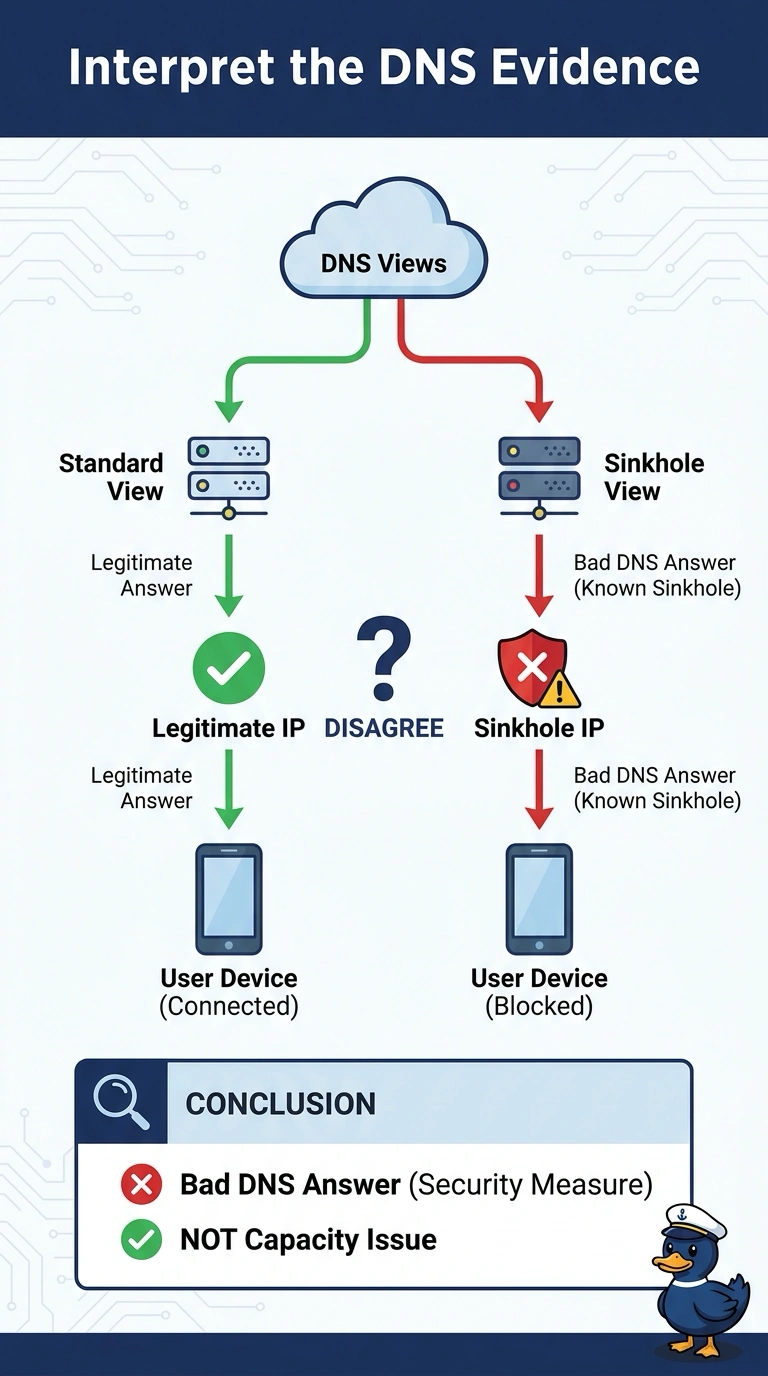
At a university, two DNS views for the same name disagree, and the address users receive matches a known sinkhole. Which interpretation fits the evidence?
Select an answer to reveal the explanation.
Short Explanation
Two clocks that disagree, with one of them set to a sinkhole, mean you check the clock and not the width of the road. You treat the university's sinkhole address as a bad DNS answer. More bandwidth, a QoS retune, or a new student laptop does not correct that name.
Full Explanation
The two DNS views disagree, and the address users receive matches a known sinkhole. The symptom is a bad DNS answer, not a campus link that is short of capacity. Increasing bandwidth because some names seem slow treats a wrong destination as a throughput problem, and a larger circuit will still send students to the sinkhole address. Retuning QoS so DNS is marked ahead of other traffic can change how quickly the query is carried, and the answer content stays the sinkhole address. Replacing the student laptop that accepted the address blames one client for a name the resolver handed out; any other client of that view can receive the same sinkhole. Exam caveat: a security team may sinkhole a name on purpose, so confirm whether this sinkhole is the university's own control, and either way the finding remains the DNS answer rather than the circuit. Operational check: compare both views for the name, identify which view returns the sinkhole, and retest after that view is corrected. If users still receive the sinkhole address, capacity work and a laptop swap have not fixed resolution.