
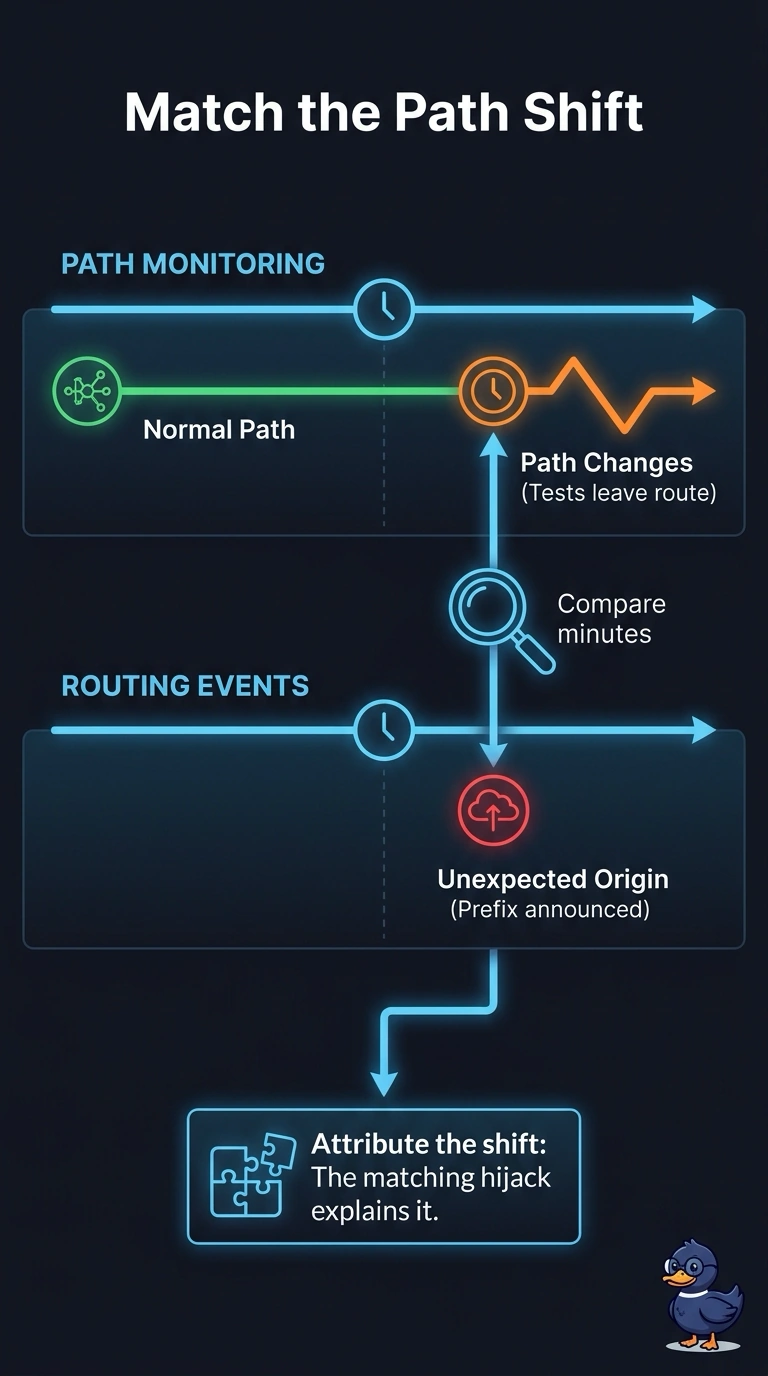
At a logistics hub, tests left the normal path during the same minutes a prefix was announced from an unexpected origin. What explains that shift?
Select an answer to reveal the explanation.
Short Explanation
If the detour sign goes up in the same minute your bus leaves the usual road, believe the sign. You attribute the path shift to the hijack that lines up with the minutes the tests left the normal path. Extra bandwidth, a quality-of-service retune, or a new laptop does not explain a prefix that moved to an unexpected origin.
Full Explanation
The tests left the normal path in the same minutes the prefix was announced from an unexpected origin. That time match is the hijack drawing traffic off the usual path, not a local quality-of-service event. Adding bandwidth on the usual circuit assumes the path change means the circuit was full. Fullness is not what the evidence shows, and a short-lived origin change explains the minutes without a capacity story. Retuning quality of service treats the move as a marking problem on the existing path. Marking does not change the BGP origin, and it cannot account for a path shift that begins and ends with the unexpected announcement. Replacing the laptop that was in use during those minutes blames whichever client happened to be active. The path change is visible in the tests and in the origin, so it is not an endpoint hardware fault. When the unexpected origin is withdrawn, the tests should return to the normal path. That correlation is the operational signature of the hijack. Exam caveat: do not prescribe a quality-of-service change for a path that moved because the prefix origin moved. Operational check: align the minutes of the unexpected origin with the minutes the hub's tests left the normal path, and confirm they coincide.