
A university's public prefix shows up at an unexpected BGP origin while users say the campus site is unreliable. What does that routing evidence indicate?
Select an answer to reveal the explanation.
Short Explanation
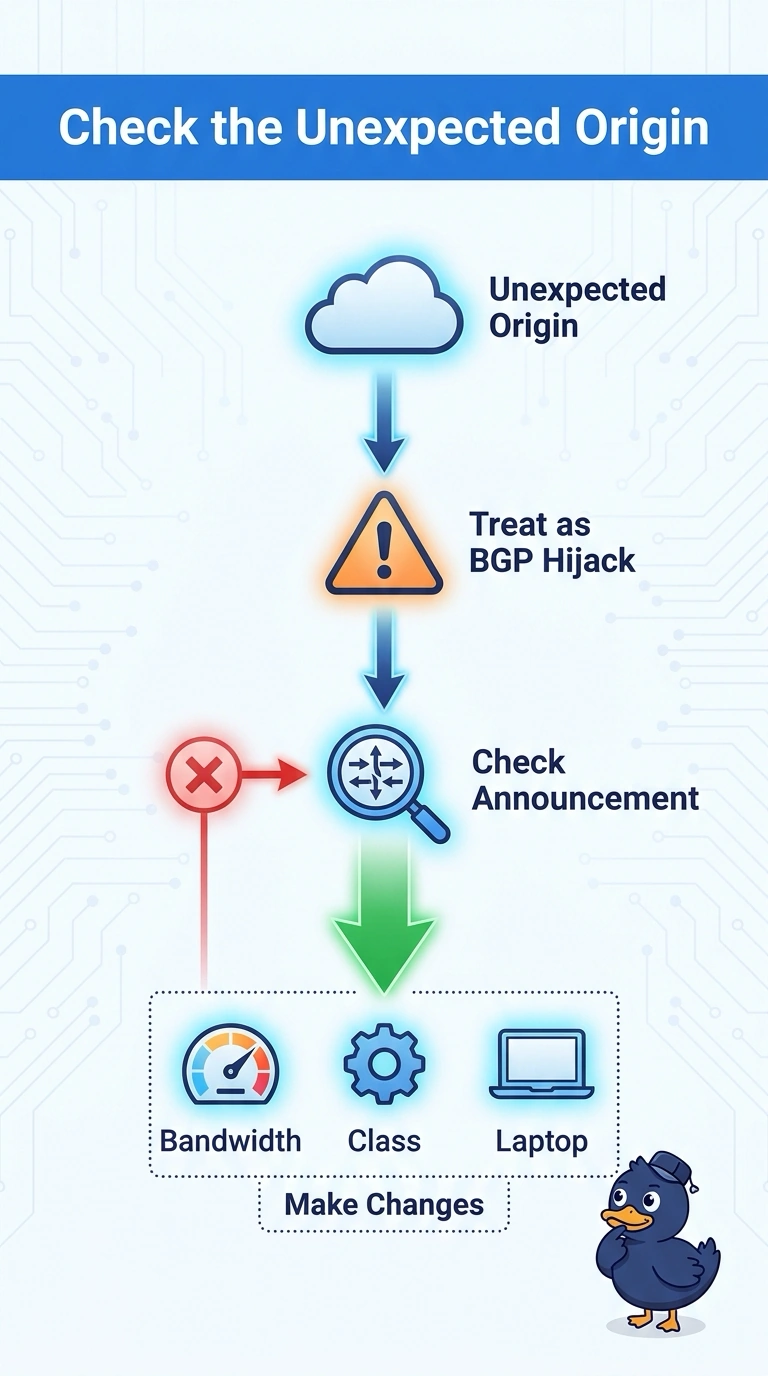
If your house number shows up on someone else's street, repainting your lane lines will not bring it home. You read an unexpected BGP origin for the university prefix as BGP hijacking. Adding bandwidth, retuning quality of service, or replacing laptops does not explain a prefix that is being originated somewhere else.
Full Explanation
BGP origin is the autonomous system announcing the prefix. When the university's public prefix appears at an unexpected origin, someone else is originating that reachability, which is BGP hijacking. User complaints that the campus site is unreliable fit traffic being drawn toward the wrong origin. Adding bandwidth on the campus edge assumes the link is full. An origin change is not a utilization reading, and a larger circuit does not pull the prefix back to the legitimate origin. Retuning quality of service re-marks traffic on the path the campus still controls. Marking does not correct a global announcement that sends users somewhere else. Replacing user laptops treats an endpoint as the fault. Laptops do not originate the university prefix in BGP, so swapping them leaves the unexpected announcement in place. Validate the observed origin against the origin the university expects, then work the hijack with the operators who announce the prefix. Exam caveat: unreliable reachability plus an unexpected origin is a routing security event, not a local capacity or endpoint symptom. Operational check: compare the origin on the current announcement with the origin the campus network is supposed to use for that prefix.