
A hospital campus waterfall for a clinical application shows connection reuse off, so every object pays a new handshake while the network path itself stays short. Which finding should the team treat as the cause?
Select an answer to reveal the explanation.
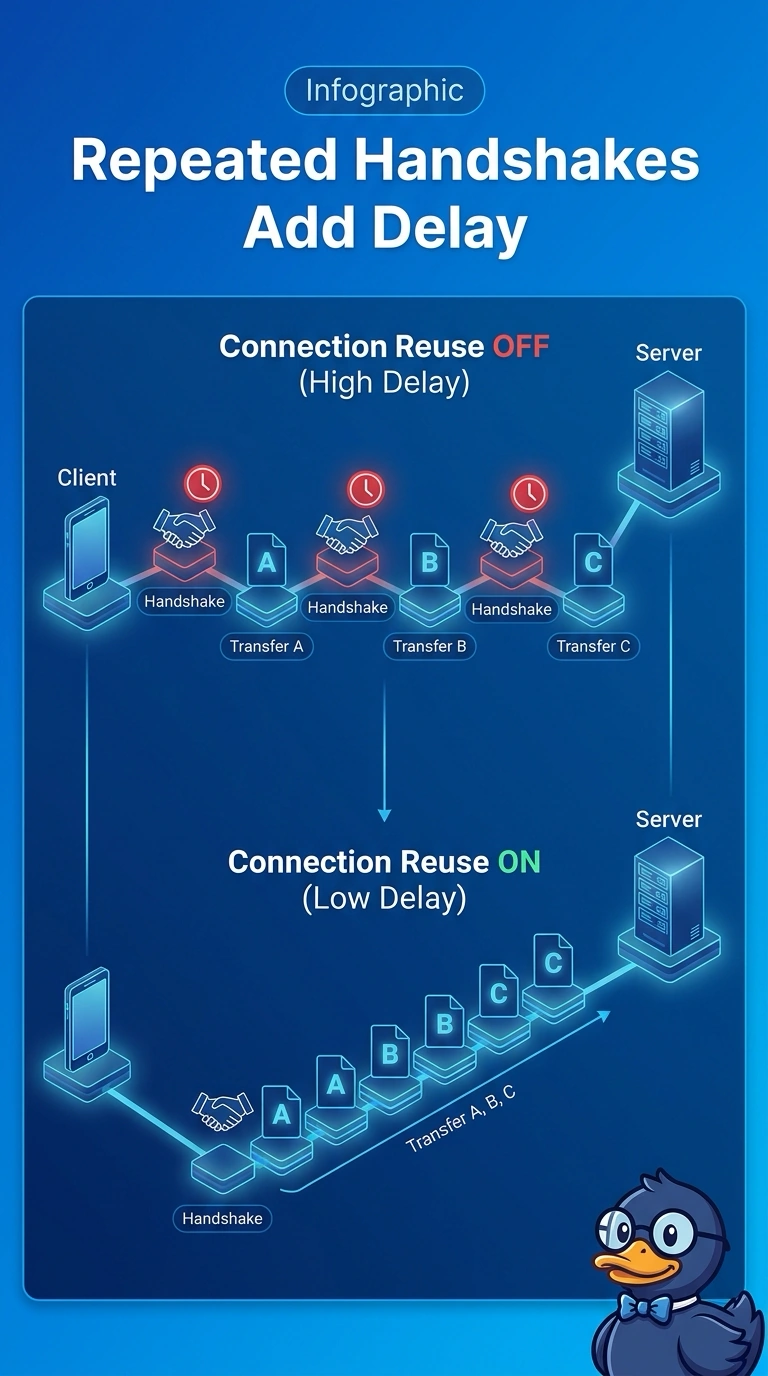
Short Explanation
Paying a fresh toll at every booth is a property of the trip, not proof the road is full of potholes. You treat the disabled connection reuse as the cause, because each object pays a new handshake on a short path. A loss alarm, a DNS hijack conclusion, or a QoS change misreads that connection behavior.
Full Explanation
With connection reuse off, the browser starts a new connection handshake for every object, so delay stacks up even when each individual path measurement stays short. Connection behavior that opens a new handshake for every object on an otherwise short path is the cause, because the waterfall shows the extra handshakes and shows that the underlying path is not the long part. A WAN loss alarm that reads each new handshake as packet loss on the clinical path confuses setup cost with drops. Loss would appear as missing packets on the path, which a short path with repeated handshakes does not establish. A DNS hijack conclusion drawn because the clinical app opens a fresh handshake per object mixes up connection setup with name resolution. A hijack would send the name to an unexpected destination, not force a new handshake on the right host. A QoS change aimed at handshake delay even though the waterfall shows a short network path retunes scheduling for a path that is already short and leaves the reuse behavior untouched. Exam caveat: repeated connection setup on a short path is a connection-behavior finding, not a loss or hijack finding. Operational check: on the clinical waterfall, confirm each object starts a new handshake and that the path portion of those objects stays short.