
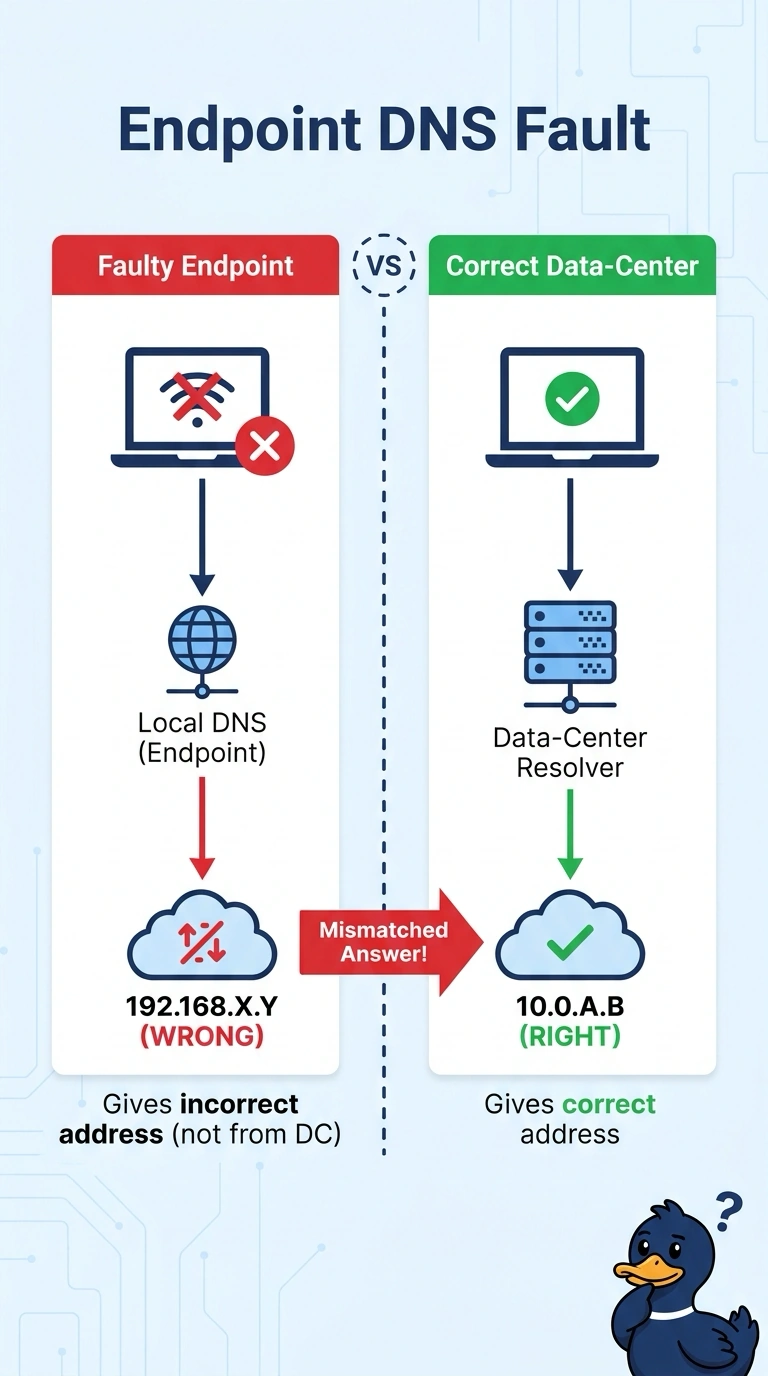
At a university, an endpoint resolves a service name to the wrong address while the data-center resolver returns the correct address for the same name. What is at fault?
Select an answer to reveal the explanation.
Short Explanation
You can trust the comparison: the endpoint gives a different address from the data-center resolver for the same name. Fix DNS on the endpoint, because changing the WAN circuit, responding to an unrelated BGP alert, or moving the agent that already resolves correctly leaves the endpoint’s lookup at fault.
Full Explanation
Name resolution depends on the resolver the client asks. The endpoint returns an address that the data-center resolver does not return for the same name, so DNS on the endpoint is at fault; the endpoint may be using an incorrect server, suffix, or stale record. Replacing a WAN circuit does not address a mismatch in the name lookup: the comparison shows that both resolvers answered, and their answers differ. A BGP alert for a route this resolver comparison does not implicate concerns routing state that the test did not flag; it does not explain why the endpoint and data-center resolver return different addresses. Moving the data-center agent that already resolves the service name correctly would abandon the useful comparison point and would not fix the endpoint’s resolver. Exam caveat: a resolver comparison identifies a name-resolution discrepancy, not necessarily every underlying cause of that discrepancy, so avoid declaring a path or routing incident from this test alone. Practical check: record the address returned for the same name by the endpoint and by the known-good data-center resolver, then correct the endpoint’s DNS setting until its answer matches.