
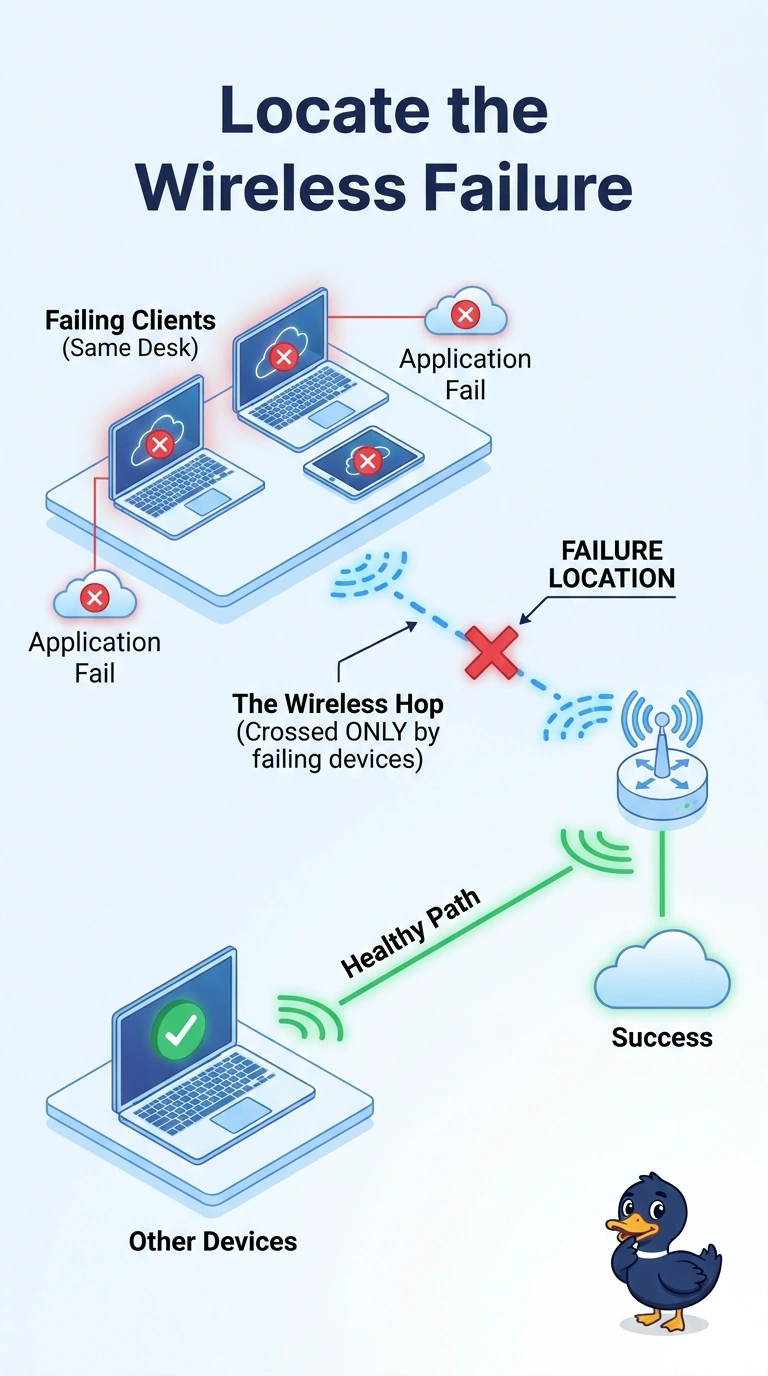
In a retail branch, wireless clients fail an application while wired clients at the same desk succeed. Where does that evidence place the failure?
Select an answer to reveal the explanation.
Short Explanation
If the lamp works when you plug it into the wall and fails on the extension cord, you stop digging up the street. Your wired clients at the same desk succeed, so the failure sits on the wireless hop only those other devices cross. A shared WAN swap, a shared BGP alarm, or a data-center agent move would disturb a path the working clients already clear.
Full Explanation
Wired and wireless clients at the same desk share the branch path beyond the access hop. Only the wireless clients fail, so the split is the wireless hop those devices cross and the wired clients do not. Replacing a WAN circuit that the successful wired clients already share would change a path the working tests have cleared, and it would not explain a failure that stops at the radio hop. A BGP alert on a route the wired clients that still succeed also use blames a route both populations traverse; a route fault would not spare the wired desks. Moving the data-center agent closer to the application servers changes a vantage point far from the branch radio and leaves the failing wireless hop untouched. Exam caveat: a symptom that follows one access method at the same desk is local to that hop, even when the application is remote. Operational check: test the same application from a wired port and a wireless client at that desk and confirm the loss or failure appears only on the wireless association.