
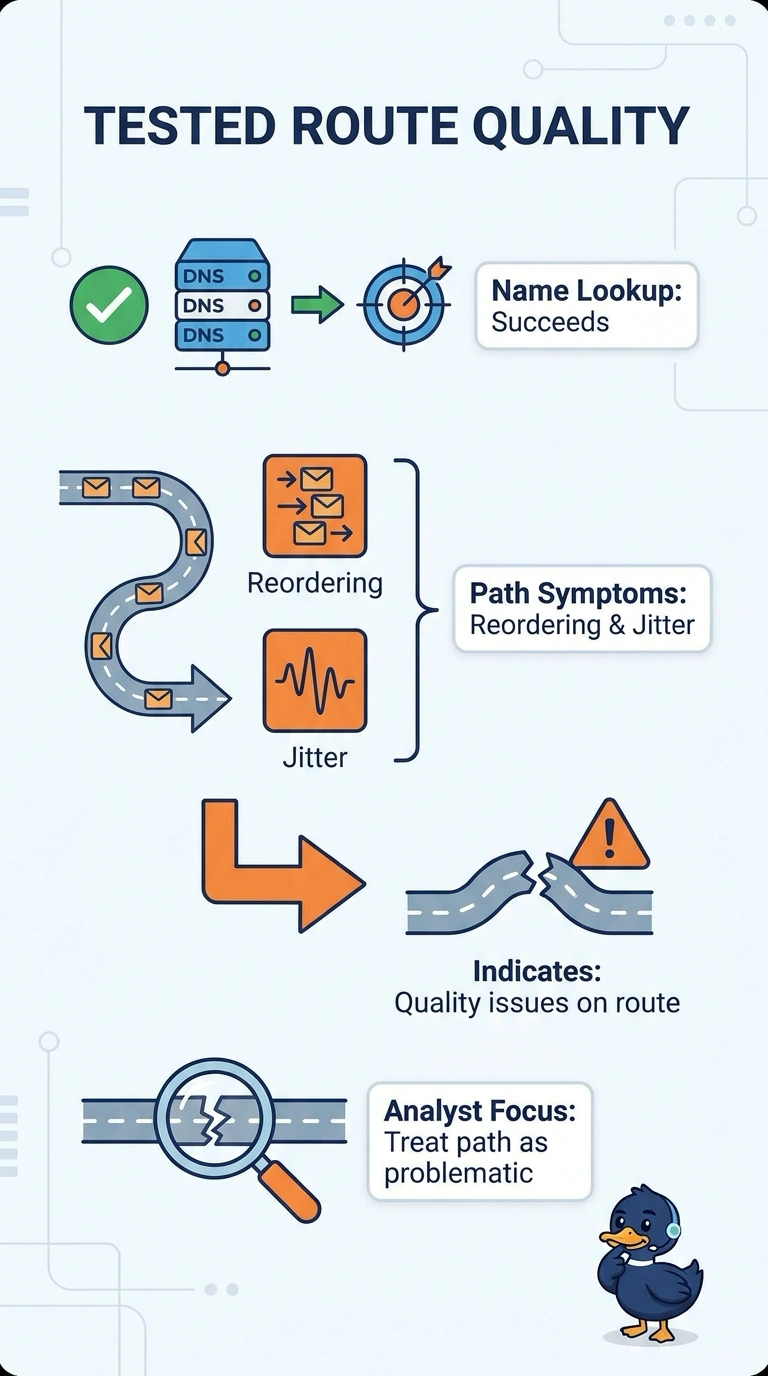
A university path test shows packet reordering together with jitter, while name lookup for the same target succeeds. What should the analyst treat as the problem?
Select an answer to reveal the explanation.
Short Explanation
Static on a phone line is a bad connection, even when you dialed the right person. You treat reordering together with jitter as path quality on the tested route, not as a bad name. The browser, a DNS-only blame, or a wireless ticket misses the path symptom you already measured.
Full Explanation
The path test shows packet reordering together with jitter, and name lookup for the same target succeeds, so the problem is path quality on the tested route. Reordering and jitter describe how packets are arriving, which is a property of the path, and a successful lookup means the name is not the thing that failed. The student browser can make a learning page feel slow, but a browser does not reorder packets or add jitter on the measured path; those symptoms are outside the rendering of the page. DNS only contradicts the test in front of you: lookup for the target succeeds, so blaming the name ignores a result that already cleared DNS. The campus wireless network is a possible ticket on a university campus, yet the reordering and jitter are on the tested path, and the question gives path-quality evidence rather than a wireless association problem, so that ticket changes the subject. On the exam, reordering with jitter points at path quality, and a successful lookup is how you refuse a DNS-only story. In production, note the reordering and jitter on the path test, confirm lookup still succeeds, and work the route that shows those path symptoms.