
A manufacturer sees loss on a path test, and fiber errors are climbing on the single interface whose counters match that loss. Where should the analyst point the fault?
Select an answer to reveal the explanation.
Short Explanation
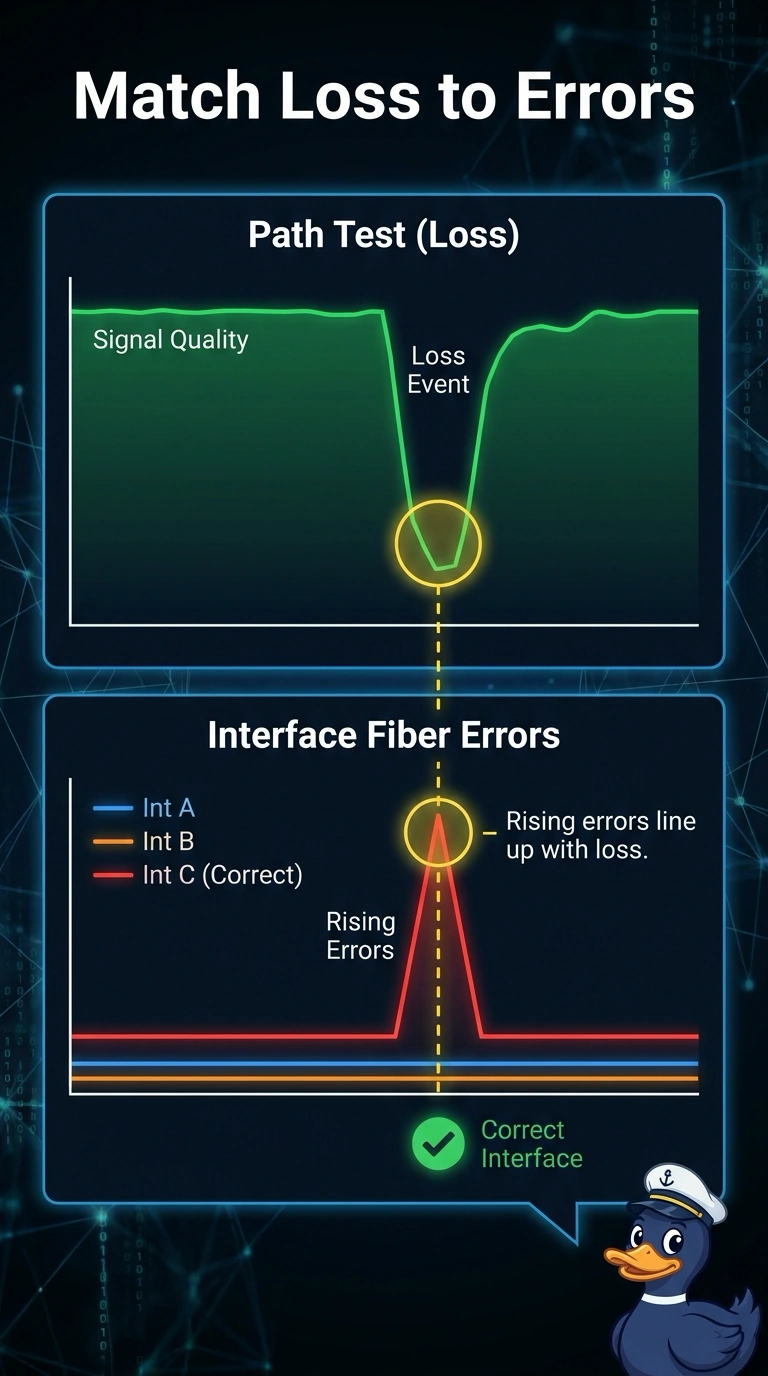
Cracks spreading across one window explain the draft on that wall. You point at the interface whose fiber errors are climbing in step with the loss. The operator browser, a DNS-only story, or a wireless ticket leaves the matching interface untouched.
Full Explanation
Loss on the path test lines up with fiber errors climbing on one interface, so the fault is that interface. The counters and the loss agree on a place, which is stronger evidence than a guess about the user application or the name. The operator browser can make a plant dashboard feel slow, but a browser does not increment fiber errors on an interface, and the path loss matches those errors rather than a rendering delay. DNS only does not produce fiber errors on a single interface either: a name problem would fail lookup, whereas this test already has a path and the loss tracks the interface errors. A wireless ticket for the plant floor sends technicians to the air, even though the fiber errors are climbing on the interface that matches the loss, so the ticket ignores the physical evidence in front of the analyst. On the exam, when interface errors climb on the same interface as the loss, point at that interface instead of a client or a name. In production, compare the path-test loss with the fiber-error counters on that interface, and confirm other interfaces that are not climbing do not match the loss.