
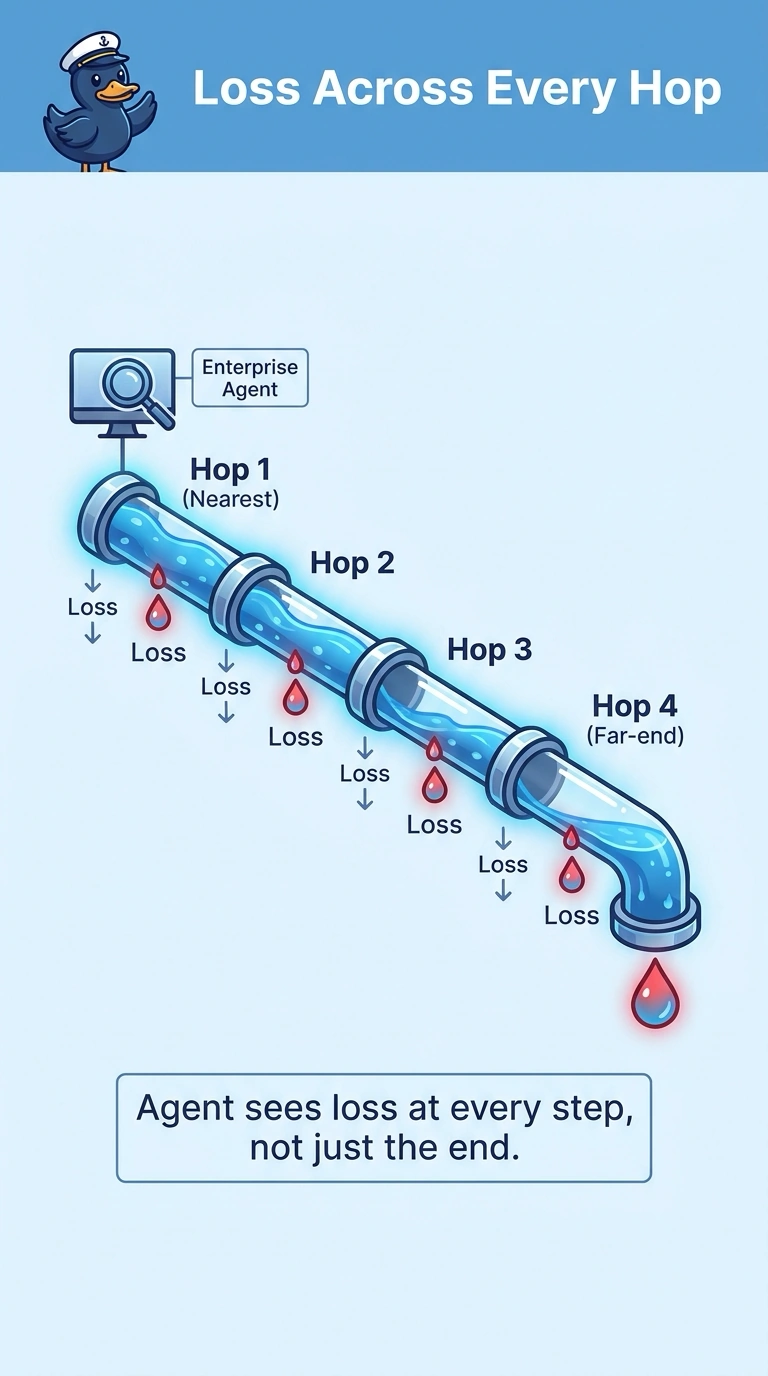
A SaaS company runs a path test for remote staff and sees loss that is random on every hop, including the first hop from the Enterprise Agent. What should the analyst conclude?
Select an answer to reveal the explanation.
Short Explanation
Blaming only the last runner is a bad call when every runner dropped the baton. You should not treat the far-end hop as the sole fault when loss shows on every hop, including the nearest. A browser theory, a DNS-only theory, or a wireless ticket ignores the path the test already drew for you.
Full Explanation
Random loss on every hop of the path test, including the first hop from the Enterprise Agent, fails the pattern for a fault that lives only at the far end. The far-end hop can still be lossy, but it is not the sole fault the measurement supports, because the same loss appears before the test ever gets there. The browser on the remote laptop can make a page feel slow, yet a browser problem does not paint random loss onto every hop of a path test that has already left the user application. DNS as the only fault does not fit either: a completed hop-by-hop test has a path, and a pure name-lookup failure would not show up as loss distributed across those hops. A wireless ticket is a reasonable guess when remote staff use home wireless, but the evidence in hand is loss on the measured path, including the nearest hop, not a wireless association symptom. On the exam, read which hops are lossy before you name a layer that the path test did not implicate. In production, compare loss at the nearest hop with loss at the far-end hop on the same test, and keep the scope on every hop that shows loss instead of closing the case on the final hop alone.