
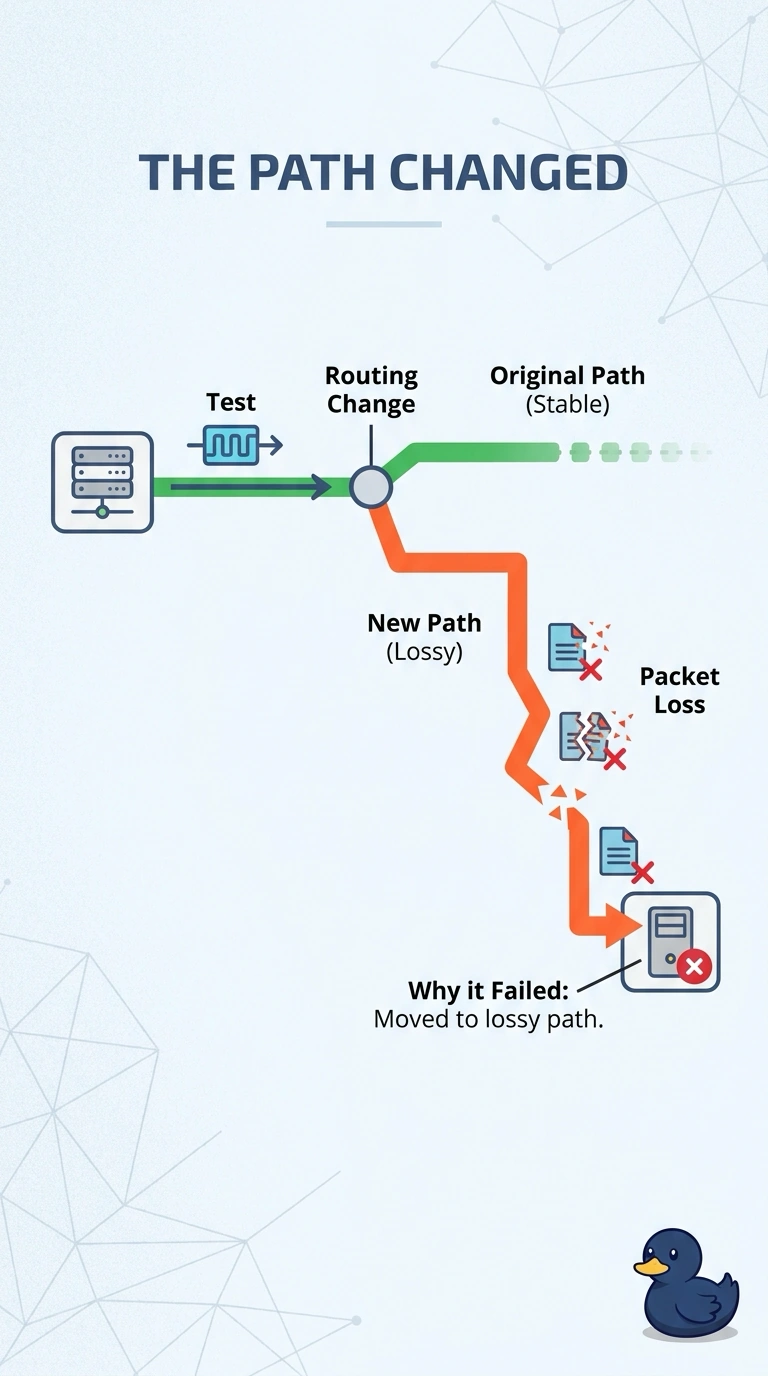
A university test to a research archive changes to a new path, and packet loss appears only along that new path. What best explains the failure?
Select an answer to reveal the explanation.
Short Explanation
When your usual road is closed and the detour is full of potholes, the new route is the problem. You treat loss that appears only on the new path as a routing change, not as a browser cache. A DNS-only failure or a wireless ticket does not match a path that moved and then went lossy.
Full Explanation
The university test moved to a different hop list, and the loss shows up on that new path rather than on the path used before. The forwarding decision changed, and the packets are being dropped along the route they now take. A routing change that moved the test onto the new path where loss appears is the explanation that ties the new hop list to the loss. A browser cache problem on the research lab workstation would reuse stored content on the client. It would not change the hop list or attach loss only to the new path. A DNS-only failure that never selects any forwarding path fails at name resolution. It does not install a new route and then show loss along that route. A wireless association fault on the residence-hall access points would be local to association or radio quality. The evidence here is a changed path that is lossy, which is a routing outcome rather than a radio ticket. Exam caveat: when the hop list changes in the same window as the loss, the routing change is the finding to test before a client-cache story. Operational check: record the path before and after the change, confirm the loss follows the new hops, and confirm the test is no longer using the old path.