
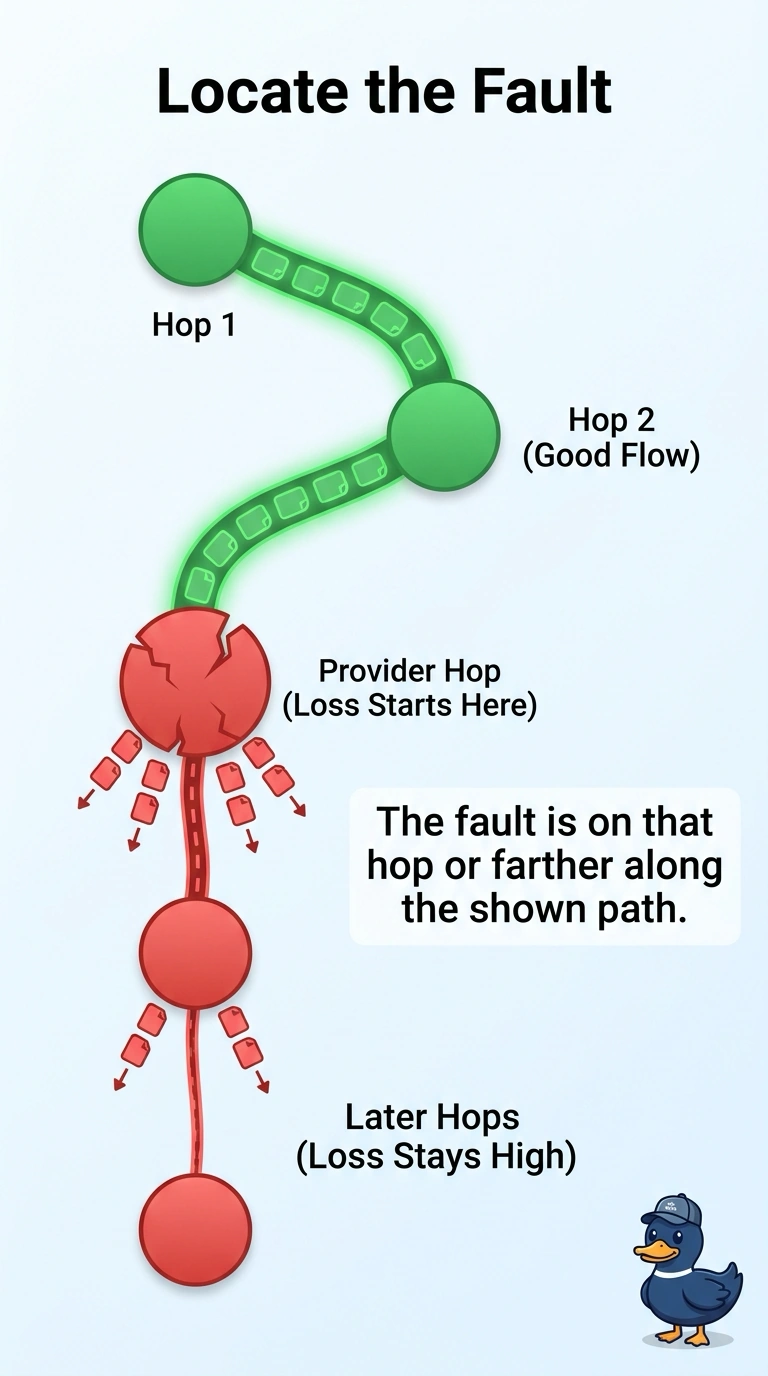
On a hospital campus, path data is clean before one provider hop, and packet loss starts at that hop and stays high on every hop after it. Where does that evidence place the fault?
Select an answer to reveal the explanation.
Short Explanation
Loss that starts at one mile marker and stays ugly for the rest of the trip belongs to that marker or the road beyond it. You place the fault on or after the hop where the loss begins, because the earlier hops are already clean. Blaming the browser, DNS, or the ward wireless ignores the path the test already drew.
Full Explanation
Path data that is clean before a hop, then lossy from that hop through every later hop, means packets start disappearing at the hop where the loss appears or somewhere beyond it. Earlier hops have already forwarded the test, so the hospital fault is not in front of that marker. The fault is on that hop or farther along the shown path, which is the reading that matches loss that begins in one place and stays high afterward. A browser rendering problem on the clinical workstation would show up as a page or client symptom on the endpoint. It would not paint loss onto one provider hop and every hop after it. A DNS-only failure that never selects or reaches the network path would fail name lookup before a forwarding path is drawn. It would not attach ongoing loss to a hop list that already exists. A wireless association problem on the ward access points would sit on the local wireless segment, which is not where this trace starts showing loss. Exam caveat: read both the hop where the metric changes and whether the change persists, because a single odd reply from one router is a different picture from loss that continues. Operational check: compare a second test to the same target and confirm the loss still begins at that hop and remains on the hops after it.