
A manufacturer enabled Cloud OnRamp for SaaS and expects it to attach branch service VPNs to a private Azure virtual network where an internal application lives. No SaaS application is involved. Why will that fail?
Select an answer to reveal the explanation.
Short Explanation
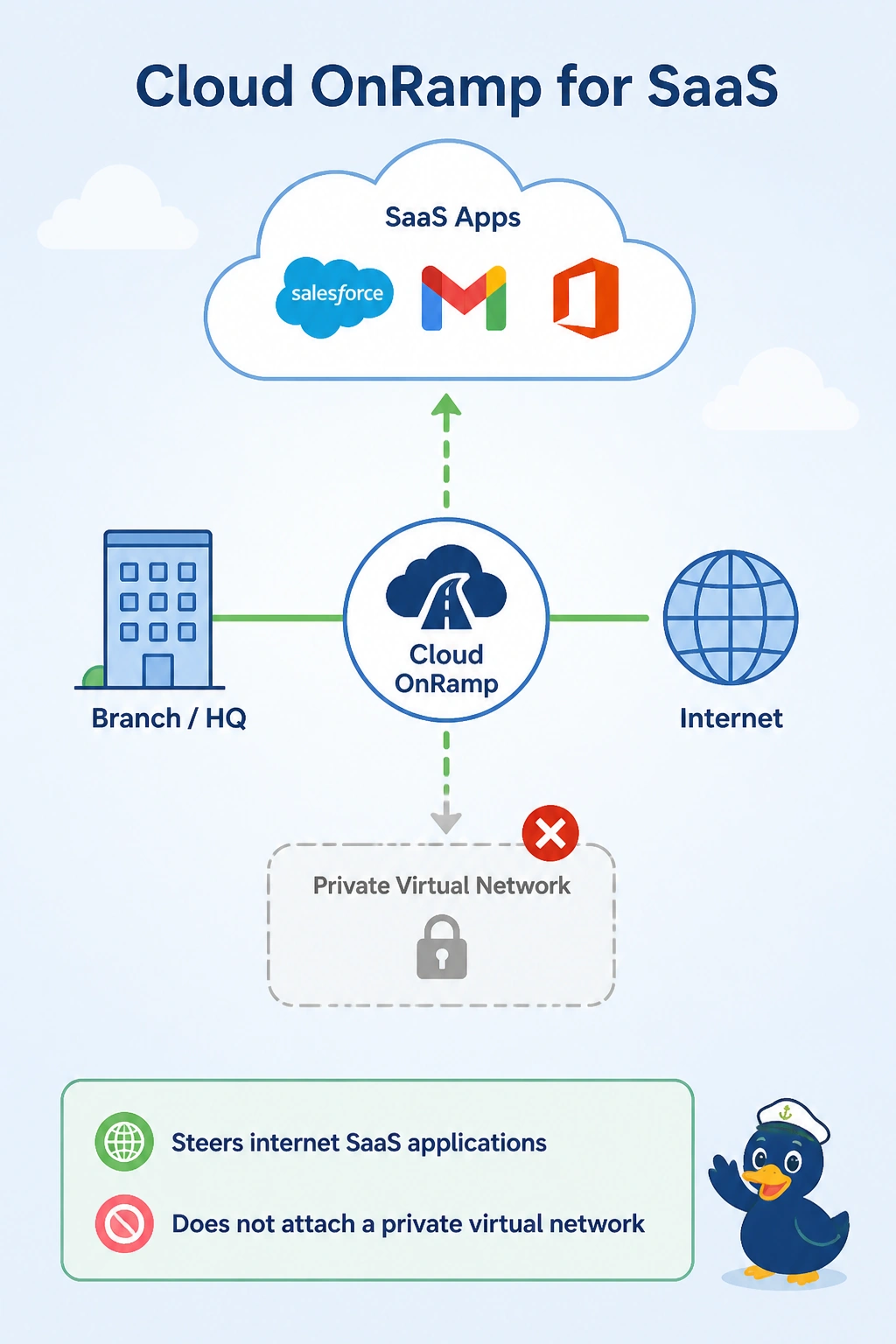
You’ve pointed a SaaS path-steering feature at a private virtual network. Cloud OnRamp for SaaS steers internet SaaS applications; it does not attach a private Azure virtual network, and no SaaS application is involved here.
Full Explanation
Cloud OnRamp for SaaS measures paths to enabled public SaaS applications and steers those applications. It does not provision a cloud gateway or attach a private virtual network, and no SaaS application is involved in this request. The internal application lives in the manufacturer’s private Azure virtual network, so the SaaS feature cannot provide the required attachment. Disabling OMP on the branch overlay would remove overlay routes; it is not a switch that makes Cloud OnRamp for SaaS attach a virtual network. Secure Internet Gateway builds tunnels to a cloud security provider for internet-bound inspection, not Azure virtual-network gateways. A zone-based firewall with URL filtering inspects or blocks traffic that can already flow; it does not create a virtual-network attachment. Exam caveat: a network can use SaaS steering and private-network connectivity for different purposes; enabling SaaS steering for a public application does not configure a private Azure virtual network. Practical check: review the Cloud OnRamp for SaaS configuration and confirm that it lists enabled public SaaS applications and path-steering settings, not a private virtual-network gateway or attachment.