
A bank's Catalyst SD-WAN branches must send web traffic through the secure internet gateway, while voice to a cloud contact center stays on the direct internet path. Which policy creates that split?
Select an answer to reveal the explanation.
Short Explanation
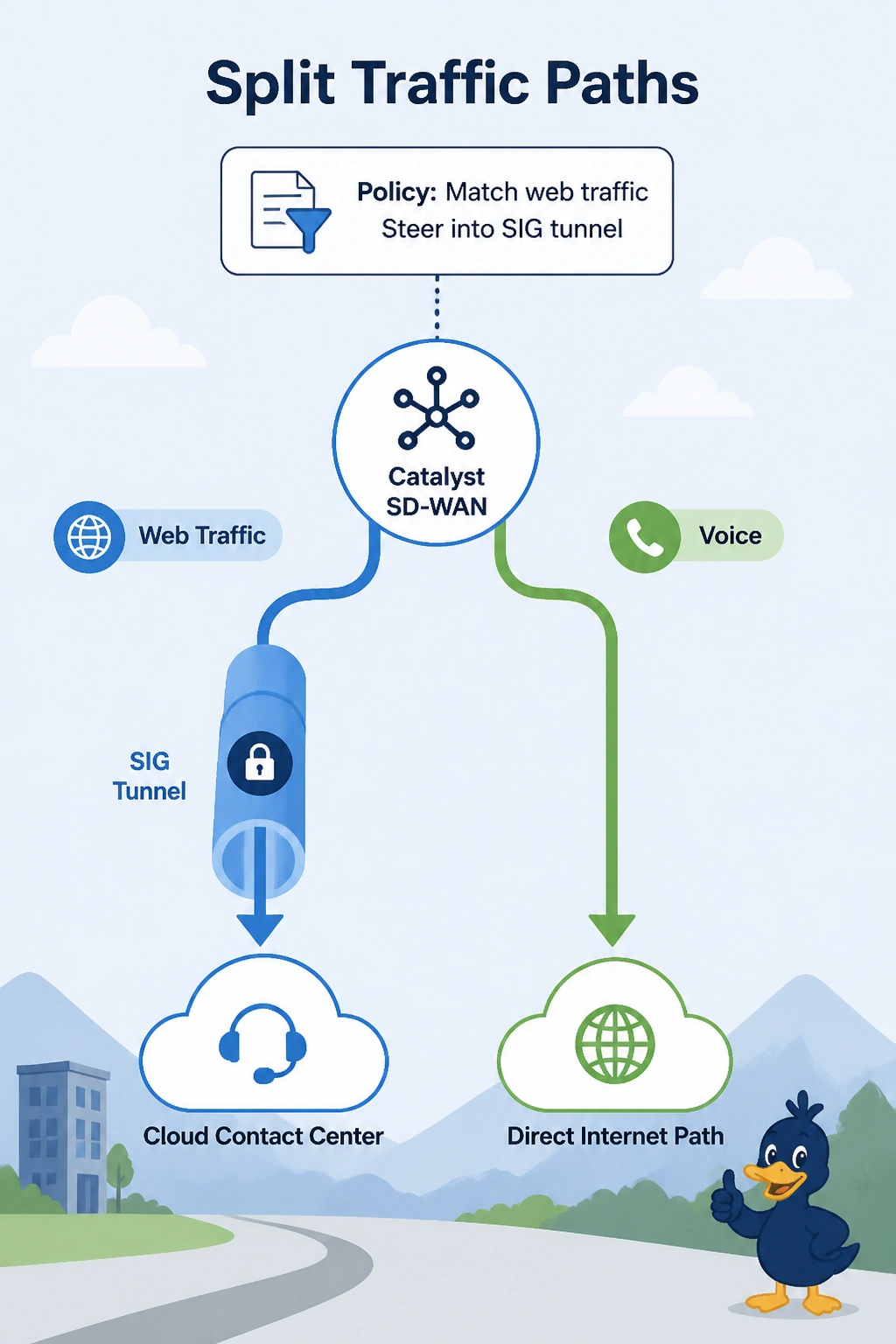
You do not send the whole truck to the inspection dock when only one crate needs a look. Match web traffic in a data policy and steer that application into the SIG tunnel. Voice never matches, so it stays on the direct internet path.
Full Explanation
Catalyst SD-WAN data policy can match an application list and set the secure internet gateway as the path for those flows only. Web matches and is steered into the SIG tunnel. Voice does not match, so it follows the direct internet path the bank already has. That is the application steering this objective is about. An application-aware routing SLA chooses among overlay tunnels by loss, latency, and jitter. It does not, by itself, pick the SIG tunnel as the exit for web. A zone-based firewall permits or denies the traffic. A rule that permits both voice and web still does not choose which exit either one uses. A control policy that withdraws every internet TLOC removes the direct internet path voice was supposed to keep, and it does not build a selective SIG steer. Exam caveat: the SIG tunnel still has to be up in VPN 0. The data policy only chooses who uses it. Operational check: a web flow from a branch should show the SIG as its path, and a voice flow to the contact center should show the direct internet exit in the same site.