
An edge has the VPC prefix through the cloud gateway and through a data-center backhaul. A control policy sets a better preference on the backhaul. Users follow the backhaul. What is steering them?
Select an answer to reveal the explanation.
Short Explanation
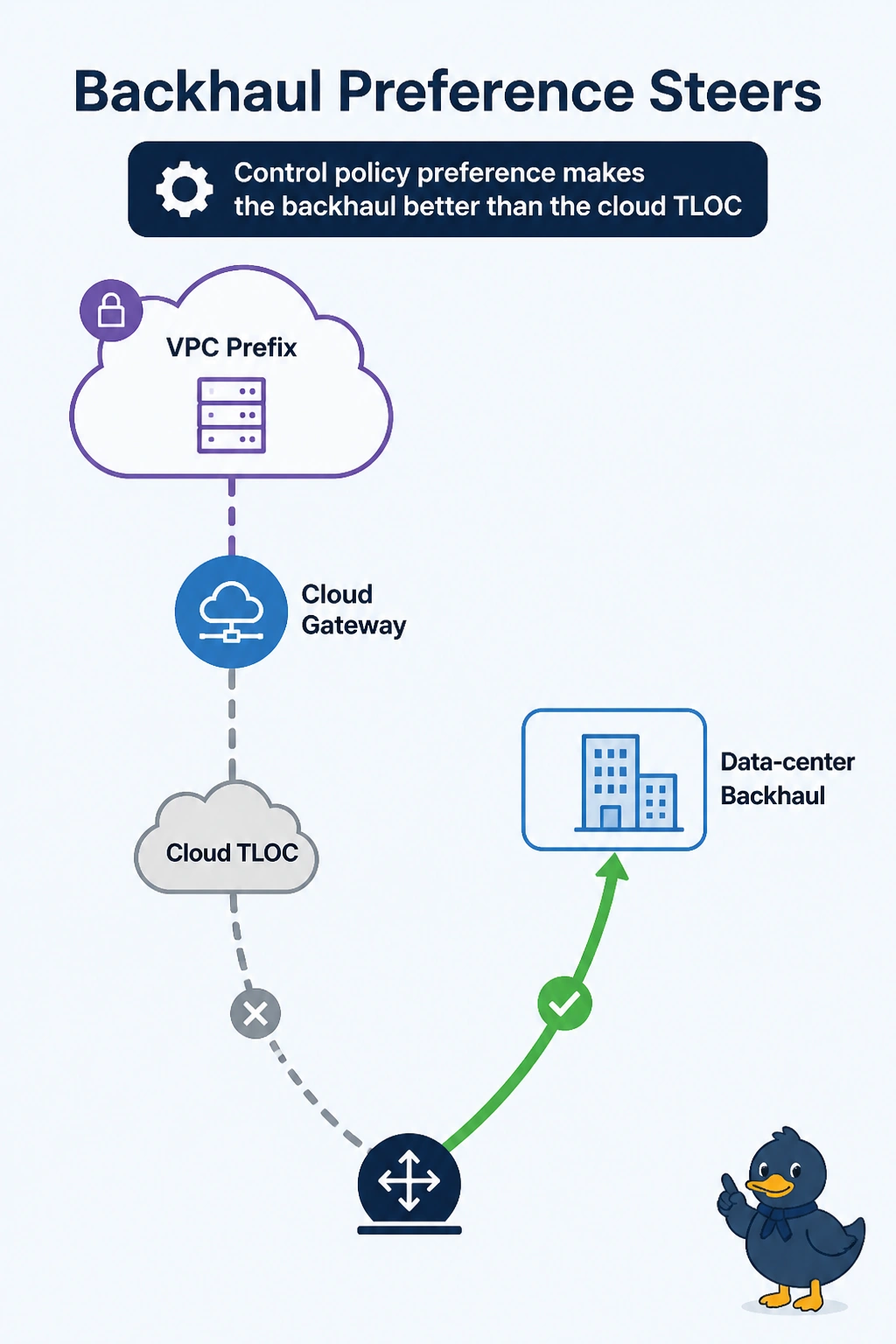
Both roads are on the map, and you’ve made the backhaul your preferred route. Your control-policy preference makes users follow the backhaul, while the cloud TLOC’s presence means it is not dead.
Full Explanation
The control-policy preference is steering users to the data-center backhaul. When the same VPC prefix is learned through both the cloud gateway and the backhaul, OMP preference determines which path is preferred; the policy makes the backhaul better than the cloud TLOC, so users follow it even though the cloud path is present. Change or remove that preference if the cloud gateway should win. A dead cloud TLOC does not explain the result: both paths are present, so the cloud TLOC is not dead. A strict SLA can drop a matched application when no tunnel meets the class, but it does not explain the backhaul winning through OMP preference while the cloud path remains installed. A zone-based firewall can drop packets, but it does not rewrite OMP preference. Exam caveat: a data policy that pins an application to a TLOC can override this path for that application, so one application may behave differently from the routing-table choice. As a practical check, inspect the OMP route detail for the higher preference on the backhaul; clearing that preference should move the prefix to the cloud TLOC.