
A campus router advertises its prefix on two AWS tunnels. Return traffic prefers tunnel 1. The advertisement on tunnel 1 has a lower MED than the advertisement on tunnel 2. AWS is using MED. Which change makes AWS prefer tunnel 2?
Select an answer to reveal the explanation.
Short Explanation
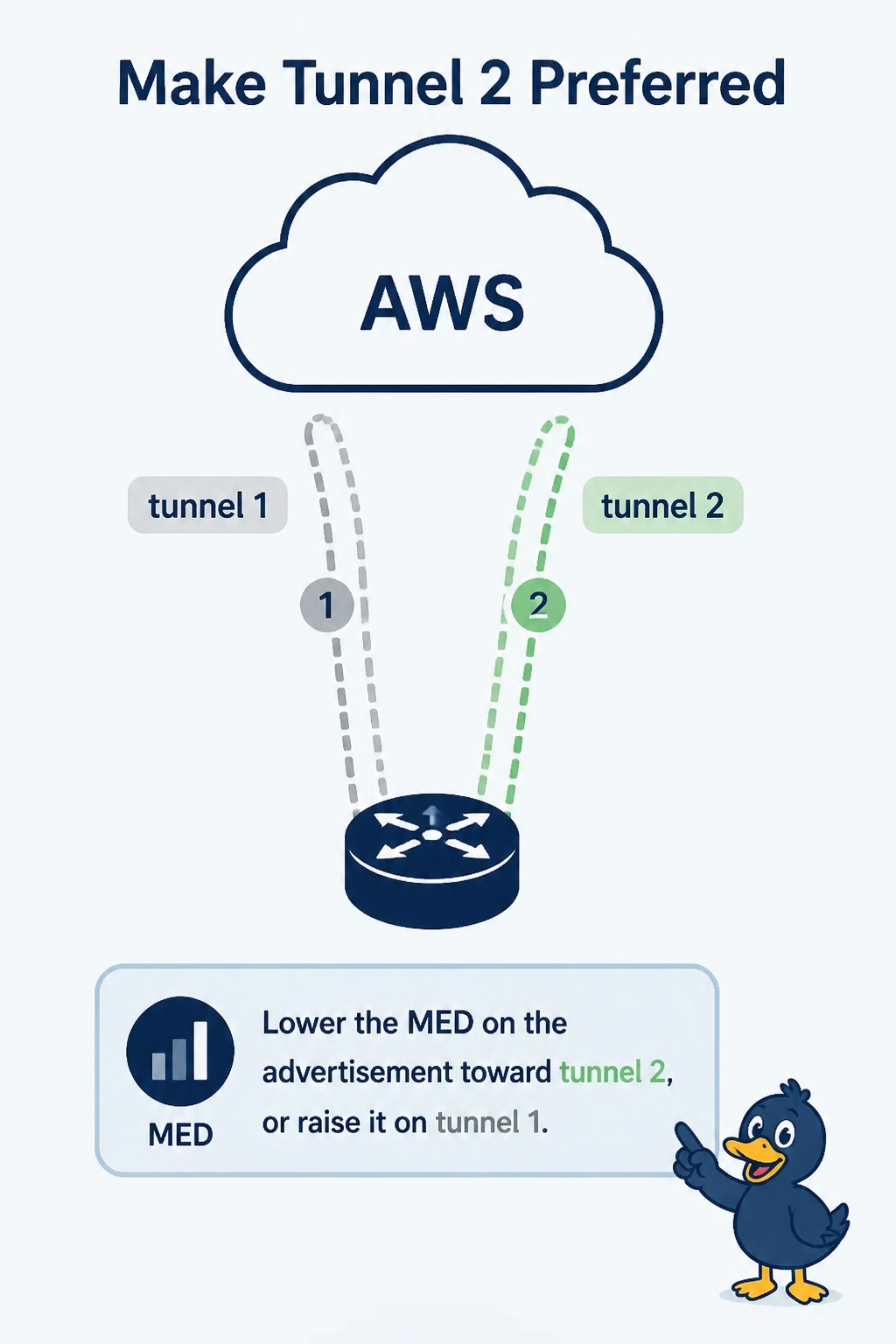
You want AWS to prefer tunnel 2, so make its advertised MED lower than tunnel 1’s by lowering tunnel 2’s MED or raising tunnel 1’s. Raising local preference on your router does not change the MED AWS uses for return traffic.
Full Explanation
When AWS honors MED, it prefers the lower value. To make AWS prefer tunnel 2, lower the MED advertised toward tunnel 2, or raise the MED advertised toward tunnel 1, so tunnel 2 has the better MED. Today tunnel 1 carries the lower MED, which is why return traffic prefers it. Raising local preference on the campus router selects the campus outbound path; it does not change the MED AWS reads for return traffic. Lowering OSPF cost on the virtual private gateway does not help because the gateway does not use that campus OSPF cost to choose between these BGP advertisements. Shortening tunnel 2’s IKE lifetime affects tunnel negotiation, not the MED advertised in BGP. Exam caveat: MED is only one step in BGP’s decision process. If AS-path lengths differ, address that before expecting MED to decide the preference. Practical check: compare the MED values AWS receives for both tunnels, confirm tunnel 2’s is lower, and verify that return traffic moves to tunnel 2.