
A campus IOS XE router learns its AWS VPC prefix by eBGP across the IPsec tunnel. The team wants a static route to a second tunnel to be used only when that BGP route disappears. Which distance should the static use?
Select an answer to reveal the explanation.
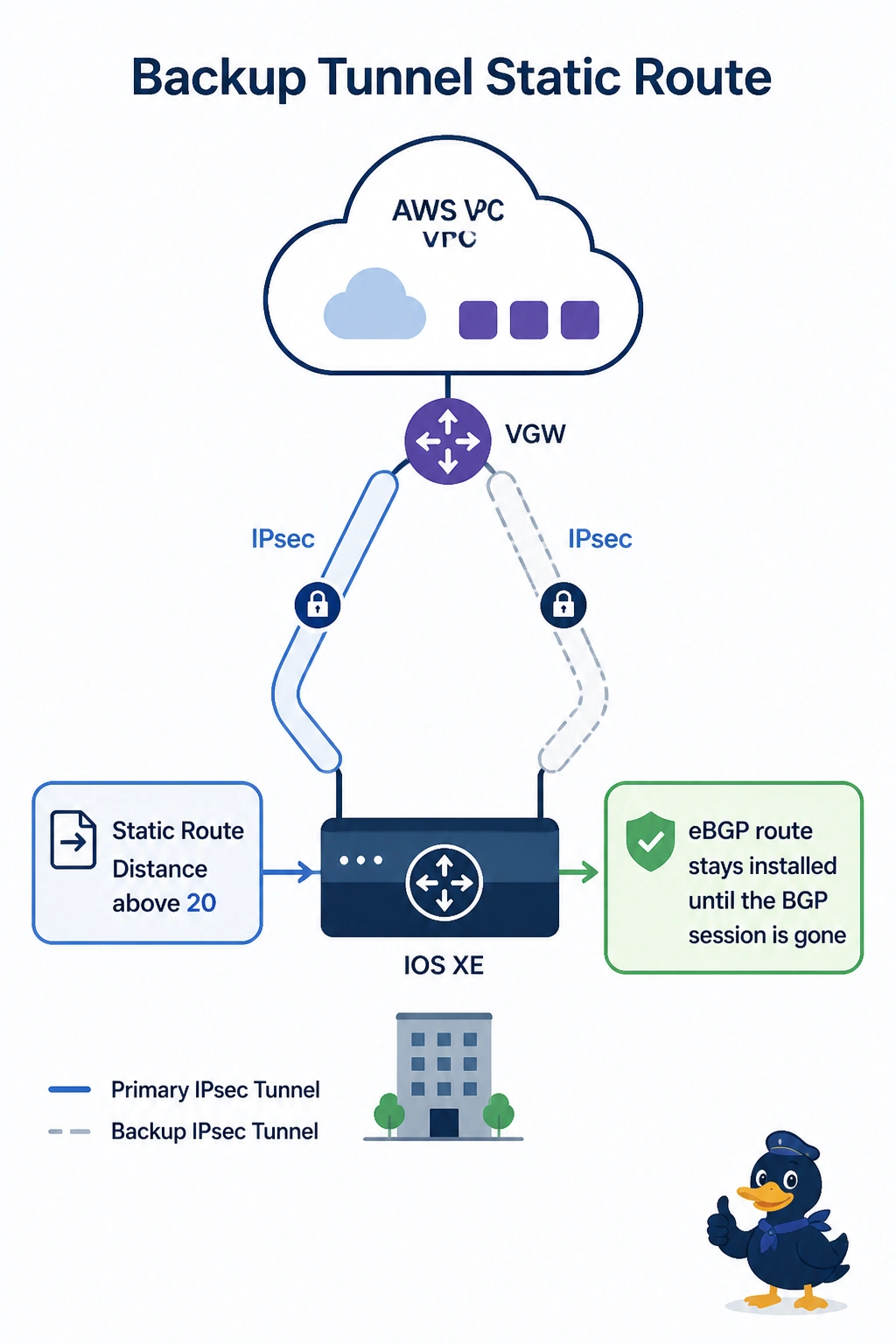
Short Explanation
A backup key belongs in the drawer, not in the lock, while the main key still works. You set the static above 20 so eBGP wins until the session disappears. Distance 1 would shove the BGP route aside on a healthy day, and eBGP is not distance 110.
Full Explanation
eBGP's administrative distance on Cisco IOS XE is 20. A static route defaults to 1 and would win whenever it exists, which is the opposite of a backup. Set the static's distance above 20, commonly well above it, and the routing table keeps the eBGP VPC prefix while the session is up. When the session drops, the floating static enters the table and points at the second tunnel. Distance 110 is OSPF, not eBGP. Using 110 on the static can work as a float only because it is still worse than 20, but calling 110 the eBGP distance is the wrong fact and will mislead the next change. Distance 0 is not a configurable static distance. Connected routes use 0, and a static cannot become connected by typing 0. Exam caveat: the second tunnel has to be a real path. A floating static toward a tunnel that is also down does not restore the VPC. Operational check: with BGP up, show ip route for the VPC prefix should show the BGP next hop. Shut the BGP session and the same prefix should switch to the static.