
A gallery's router sits in its colocation cage, and the cross-connect to the cloud on-ramp lands on that router. Someone proposes moving the router to the gallery and leaving the cage empty. What does this design require in the cage?
Select an answer to reveal the explanation.
Short Explanation
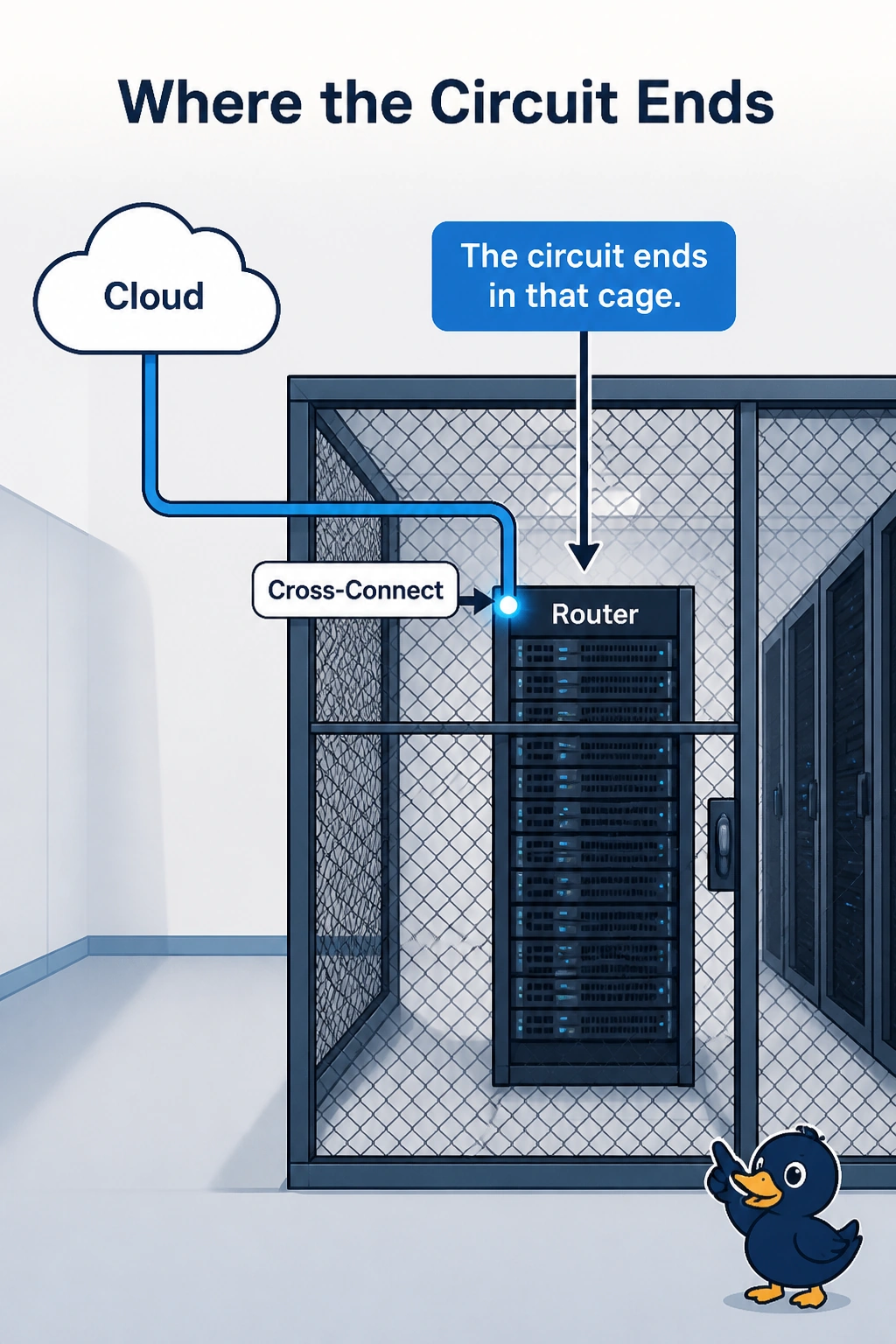
The cross-connect ends on the router in the cage; it won’t follow you to the gallery. You need to keep that router in the cage, because an empty cage leaves the circuit with nothing to terminate on—not a public-internet patch or an OMP controller.
Full Explanation
In this colocation design, the customer orders a physical cross-connect from the cage to the cloud on-ramp, and the router in the cage terminates that connection. Moving the router to the gallery leaves the cross-connect in the cage without its endpoint, so the private path cannot terminate there; the cross-connect does not follow the router. A cage with no equipment therefore cannot support this circuit. A patch to the public internet does not replace the physical cross-connect: colocation is not simply an internet VPN, and that patch would not provide the stated private on-ramp connection. A Catalyst SD-WAN controller is also not the termination point; the cage cross-connect lands on the router, not on an OMP endpoint. The required equipment is thus the router that the cross-connect lands on, which must remain in the cage. Exam caveat: identify where the cross-connect physically ends, rather than assuming that moving a router moves the circuit with it. Practical check: confirm with the cross-connect provider that the cage router interface remains the endpoint, then verify that the interface shows the cloud prefixes.