
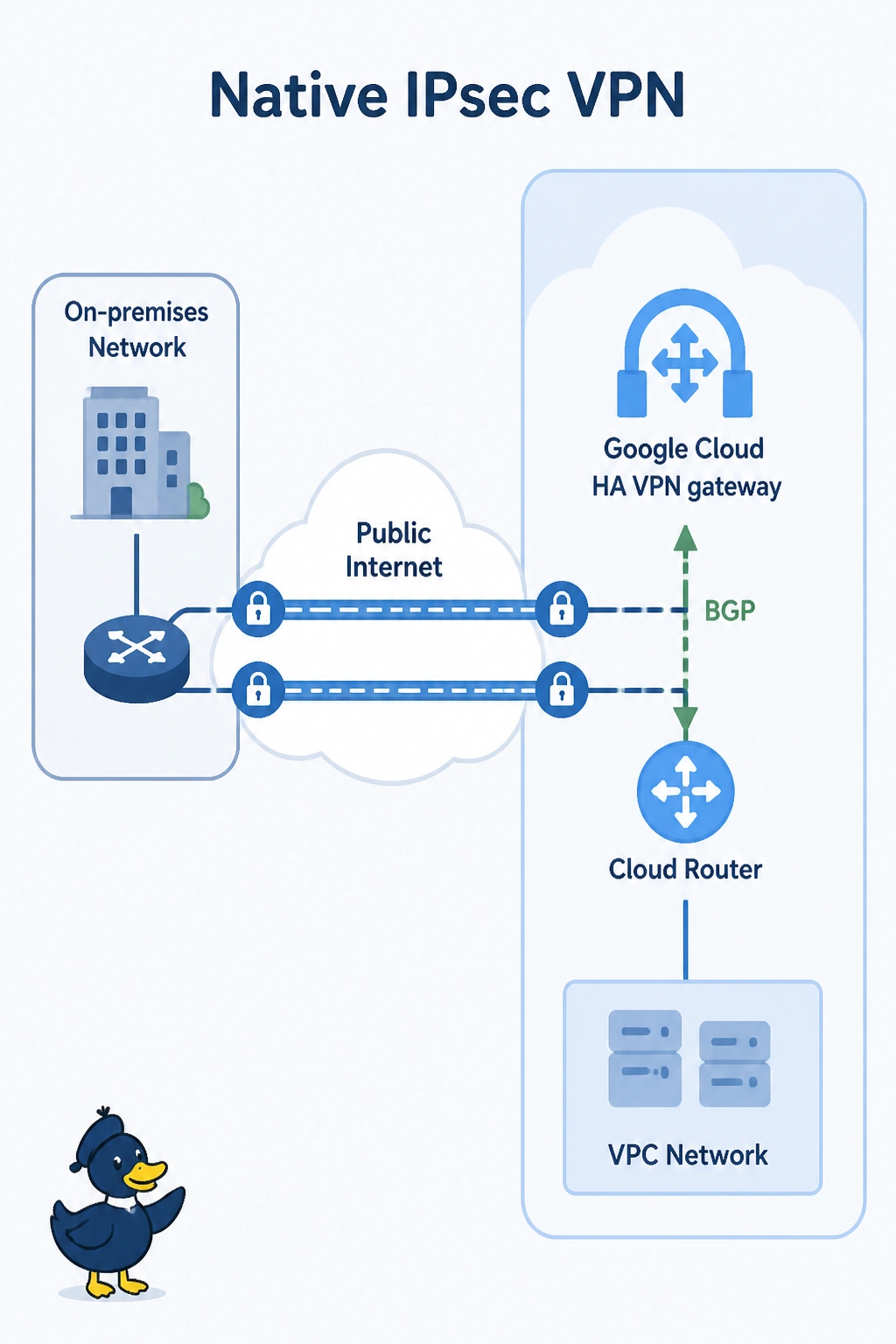
A clinic builds two IPsec tunnels across the public internet to a Google Cloud HA VPN gateway and peers BGP with Cloud Router. No interconnect port is ordered. Which model is this?
Select an answer to reveal the explanation.
Short Explanation
Two locked cases on the public road are still on the public road. You built native IPsec to the HA VPN gateway. Two interfaces and BGP do not turn that into a Cloud Interconnect port, and BGP by itself is not SD-WAN.
Full Explanation
HA VPN is Google Cloud's native IPsec service. The tunnels cross the public internet, Cloud Router exchanges BGP, and no interconnect port was ordered. That is the internet native-IPsec model, even though the gateway has two interfaces for resiliency. A dedicated Cloud Interconnect is a private port into Google's network. Using two HA VPN interfaces does not create that port. A colocation cross-connect would be the clinic's cable to Google inside a shared building. Cloud Router being a Google service does not make the clinic's internet tunnels a cross-connect. Catalyst SD-WAN cloud connectivity needs the SD-WAN overlay and controllers. BGP on a standalone router is not that overlay. Exam caveat: HA VPN's 99.99 percent configuration still uses the internet as the underlay. If the clinic later needs a private path, that is a separate interconnect, not a property of these two tunnels. Operational check: the HA VPN page should show the two tunnels to the clinic's public addresses, and no VLAN attachment should exist for this clinic.