
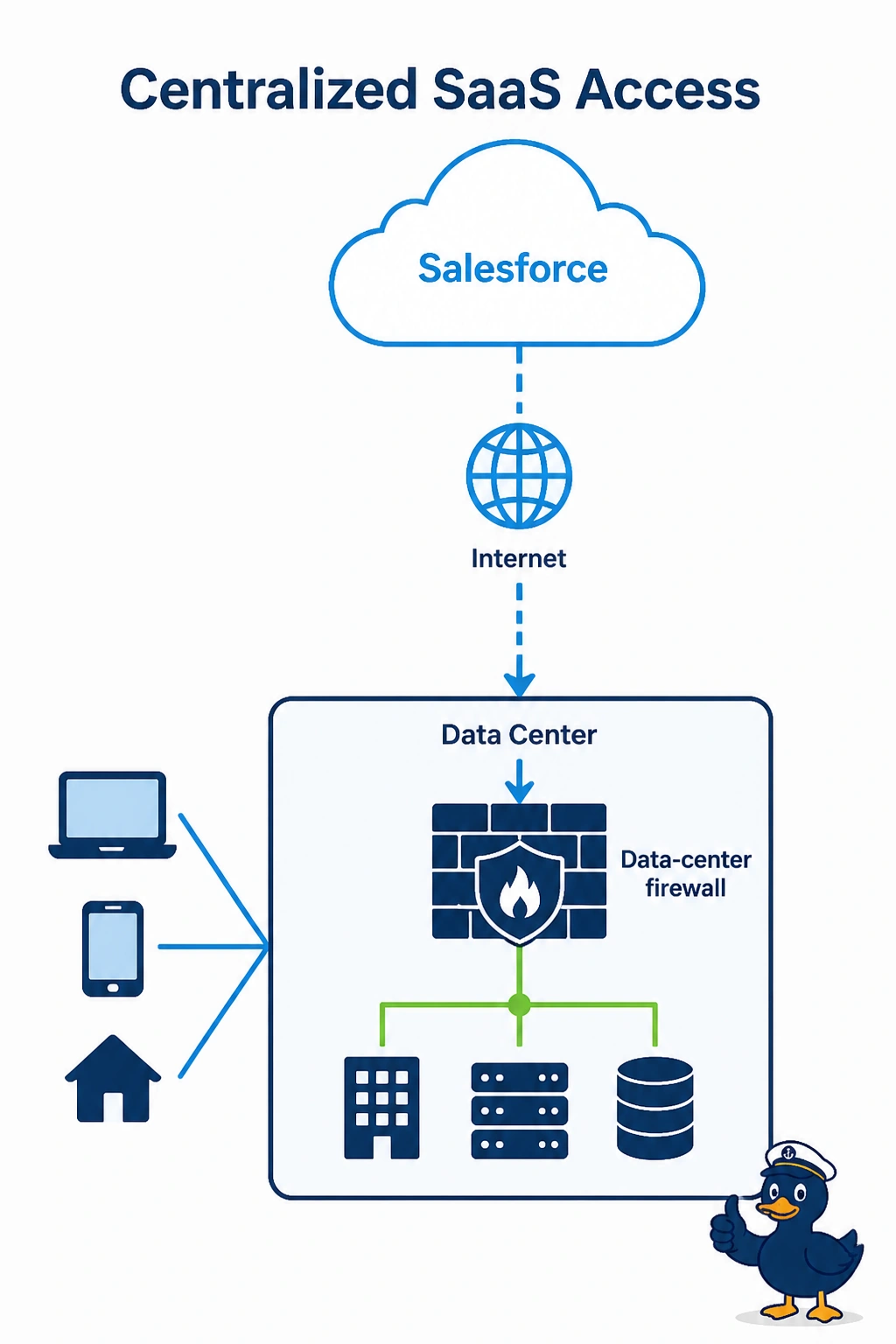
A retailer forbids local internet breakout. Every branch must send Salesforce traffic to the data-center firewall, which is the only internet exit. Which SaaS connectivity model is this?
Select an answer to reveal the explanation.
Short Explanation
Every package has to visit the same loading dock before it is allowed outside. You are backhauling Salesforce to the data-center firewall, which is a centralized internet gateway. Local breakout and a cloud security detour are different models, and nobody ordered a private circuit to the SaaS provider.
Full Explanation
A centralized internet gateway means branch SaaS traffic is carried to one exit, here the data-center firewall, and only that exit reaches the internet. The retailer forbade local breakout, so this is not direct internet access. Direct internet access would let each branch send Salesforce straight out. Indirect access through a cloud security provider would send the flow to that provider's stack first. The stem names the data-center firewall, not a cloud security provider. Dedicated connectivity is a private or peering path the SaaS provider sells so the traffic can avoid the public internet. Nothing in this design orders that path. The traffic still uses the data center's internet exit. Exam caveat: centralizing the exit gives you one policy point and adds delay and a single choke point. If a branch later gets an approved local stack, the model can change for that site only. Operational check: a branch trace to Salesforce should pass the data-center firewall's outside address, and the branch router should not have a local default toward its own internet circuit.