
A platform team must stream interface counters from 200 routers into a single dashboard, and the sensor list changes every week without editing any device configurations or causing commits. Which telemetry subscription approach fits all of those constraints?
Select an answer to reveal the explanation.
Short Explanation
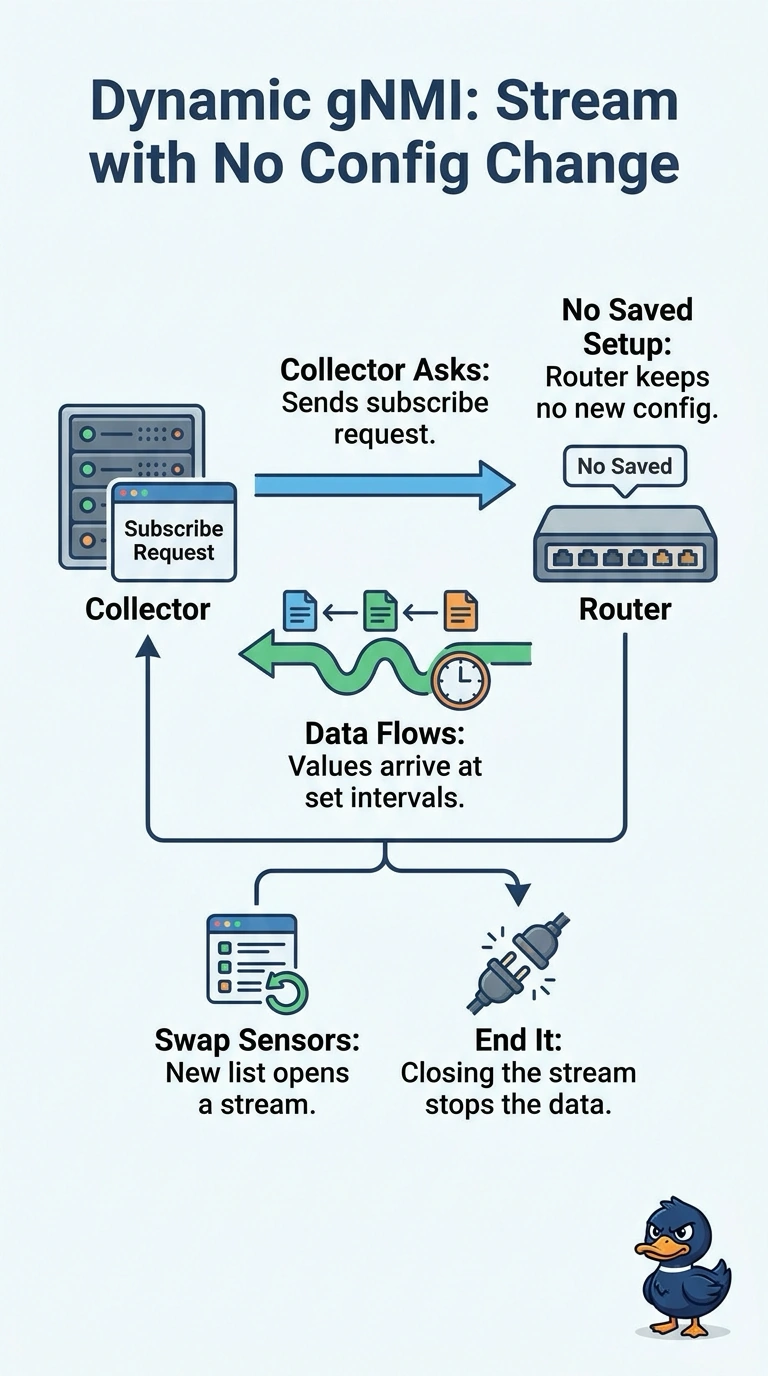
A dynamic subscription lives in the session between your collector and the router, so you can start, change, or drop it whenever you like. It's like tuning a radio in and out without rewriting the station's broadcast schedule. The dynamic subscription never becomes part of the router's stored configuration.
Full Explanation
Model-driven telemetry offers two subscription flavors, and the dynamic kind is created by sending a subscribe request over the gNMI session from your own collector, so nothing is written to the router configuration and nothing has to be committed. That satisfies both constraints at once: you can rewrite the sensor list each week by opening a new stream and closing the old one, and the 200 routers never take a configuration change. Configuring a sensor group and subscription on each box fails because every weekly edit becomes a configuration change, which is exactly what the team wants to avoid, even though the configured approach has the advantage of surviving a reboot. Applying one shared static template across the fleet fails for the same conceptual reason, since it is still device configuration and updating it triggers a configuration push on every router. Scheduled NETCONF gets fail because polling is not a subscription at all, so the routers never push measurements and you depend on request timing instead of a stream. Exam caveat: a dynamic subscription belongs to its session, so it ends when the collector disconnects. Practical check: reconnect the collector, confirm the stream restarts, and verify the device configuration never changed.