
A branch site drops traffic for a few minutes at a time while its underlay circuit stays up, and the edge router CLI shows nothing conclusive. The engineer must pinpoint whether the fault sits in control connections, BFD sessions, or overlay tunnels using only the SD-WAN Manager APIs. Which set of SD-WAN Manager API checks should the script run?
Select an answer to reveal the explanation.
Short Explanation
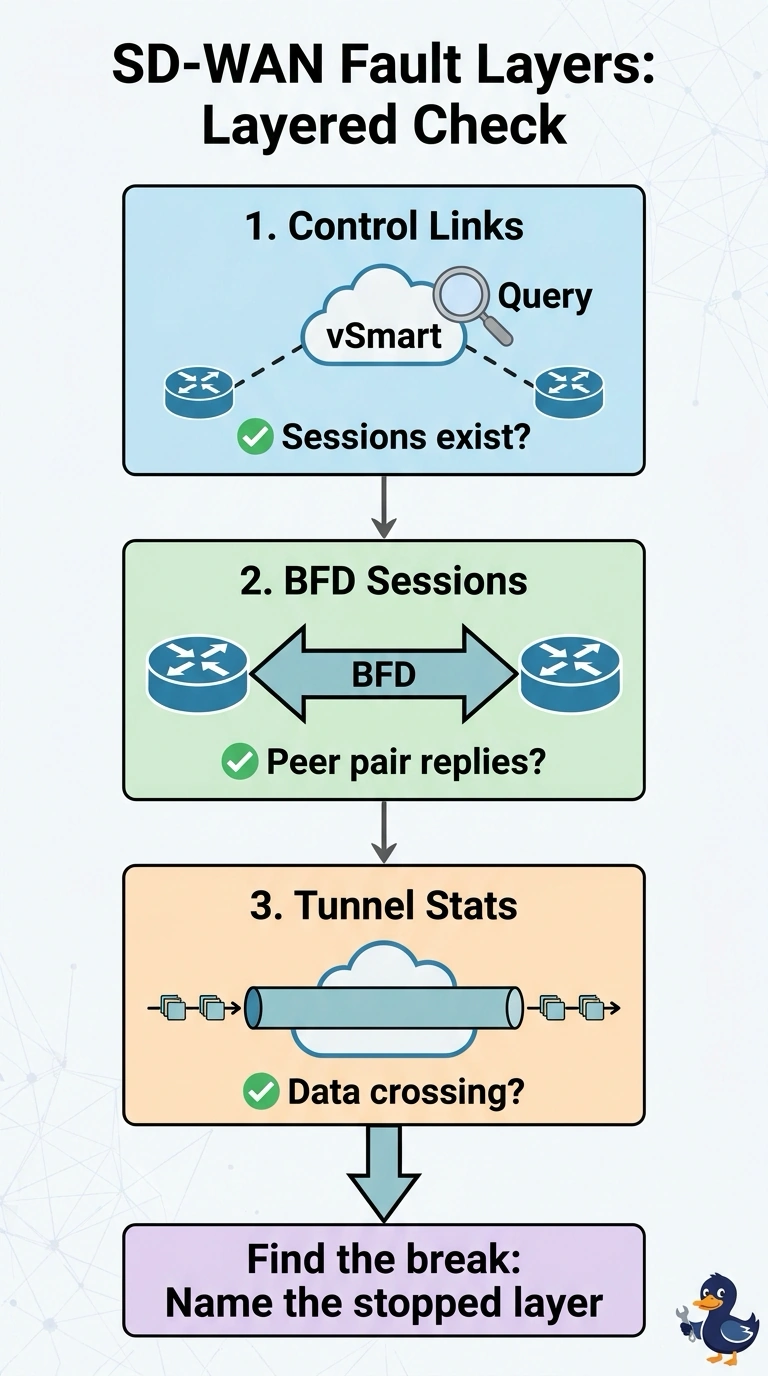
Treat it like any layered check: confirm the router is still talking to the controller before you blame the pipes. Pulling control connections, then BFD sessions, then tunnel statistics narrows the fault to one layer at a time. Guess from templates or route counts and you're missing a layer entirely.
Full Explanation
SD-WAN Manager, formerly vManage, publishes operational state through its monitoring APIs, and the three signals relevant here map to three layers of the overlay. Control connection records show whether the branch router still holds sessions to the controllers, BFD session status shows whether each peer pair is exchanging keepalives, and tunnel statistics show whether data actually crosses the data plane, so querying them in that order isolates the failing layer. Reading the WAN interface template misses runtime state completely, because a correct template says nothing about whether a control connection is up right now. Pulling tunnel counters with a CLI show command breaks the API-only constraint and hands you output that cannot be correlated programmatically with the other two queries. Inferring BFD health from OMP route counts is a proxy instead of a measurement, since routes can persist while individual sessions flap underneath. The exam caveat is that exact endpoint names shift between releases, so reason about the layer you need rather than memorizing a path. A practical check is to run all three queries in one script and compare their timestamps before drawing a conclusion.