
A branch site's overlay traffic stops while every remote site keeps forwarding. SD-WAN Manager lists the router as connected, and an API query shows its control connections established with the controllers, so the management and control planes are healthy. The team must work out whether the data path is up between this edge and its peers. Which SD-WAN Manager API data source should they read to diagnose the forwarding outage?
Select an answer to reveal the explanation.
Short Explanation
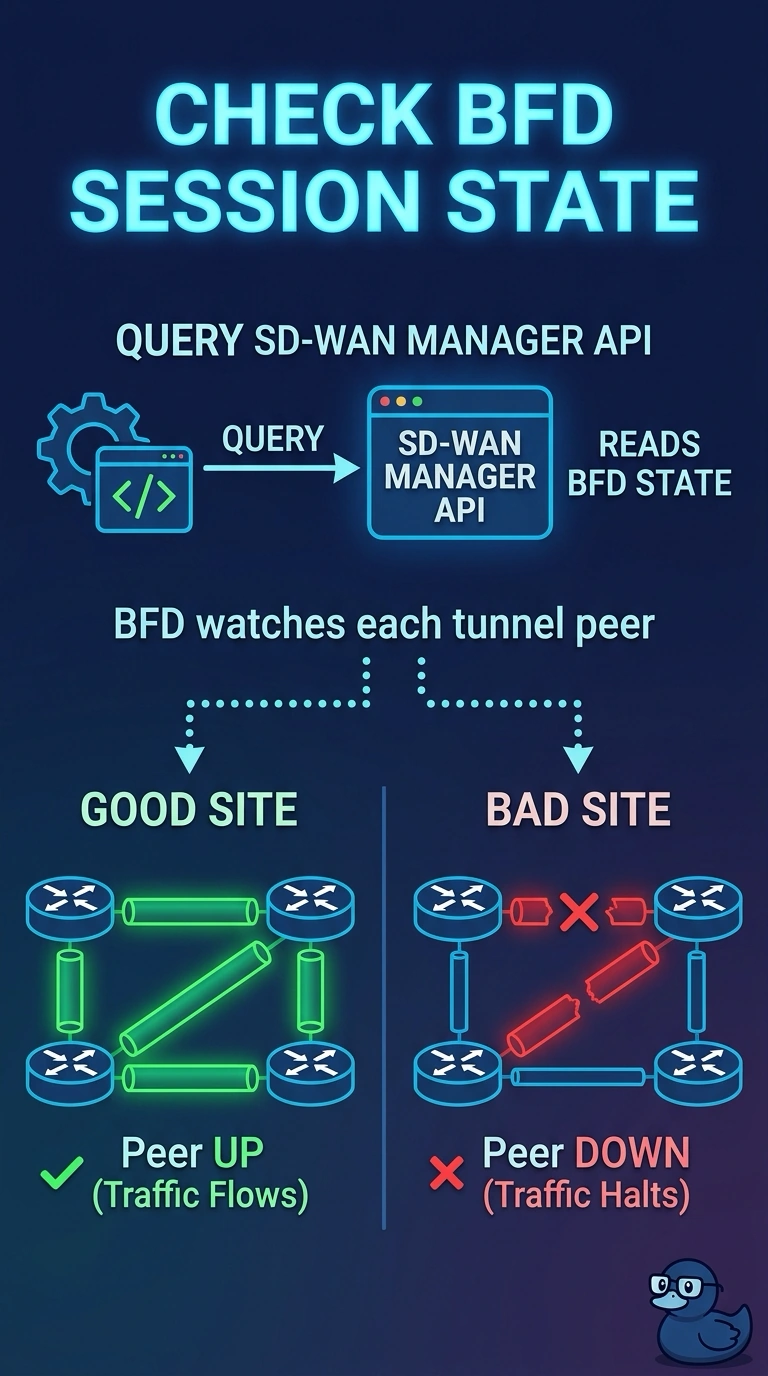
Control connections only prove the router can reach the controllers, so they can't explain a forwarding outage. The BFD sessions are the liveness signal behind the tunnels, and reading their state shows you where the data path broke. It's like checking whether the phone line works after the front desk has already answered.
Full Explanation
BFD session state is the direct data source for this question: BFD monitors forwarding-path liveliness between SD-WAN edges, and its session status identifies which peer adjacencies are down. Reading it through SD-WAN Manager’s API also meets the requirement to use an API data source. OMP route status is useful for checking control-plane route exchange and whether peer routes are available, but routes can remain present even when the forwarding path to a peer has failed; it does not establish that the data-path session is up. Per-tunnel byte counters are a practical way to inspect traffic volume on transport links, but counters may be unchanged simply because there is no traffic to send, or may reflect other traffic; they do not directly report peer-session liveliness. App-route SLA measurements help assess loss, latency, and jitter for traffic classes, but they describe measured application-path performance rather than whether the edge’s BFD sessions to its peers are established. Exam caveat: healthy management and control connections do not prove that overlay forwarding is healthy, and route presence or traffic metrics are not interchangeable with BFD state. Practical check: query the relevant BFD sessions for the affected edge, identify the peer and session state, and compare with a known-healthy peer or the same edge’s other sessions.