
A branch reports brief outages every fifteen minutes. On SD-WAN Manager the engineer sees overlay tunnels carrying packet loss and BFD sessions resetting, but the fault's origin is still unclear. Which API query gives the clearest first evidence about the health of the router's control plane?
Select an answer to reveal the explanation.
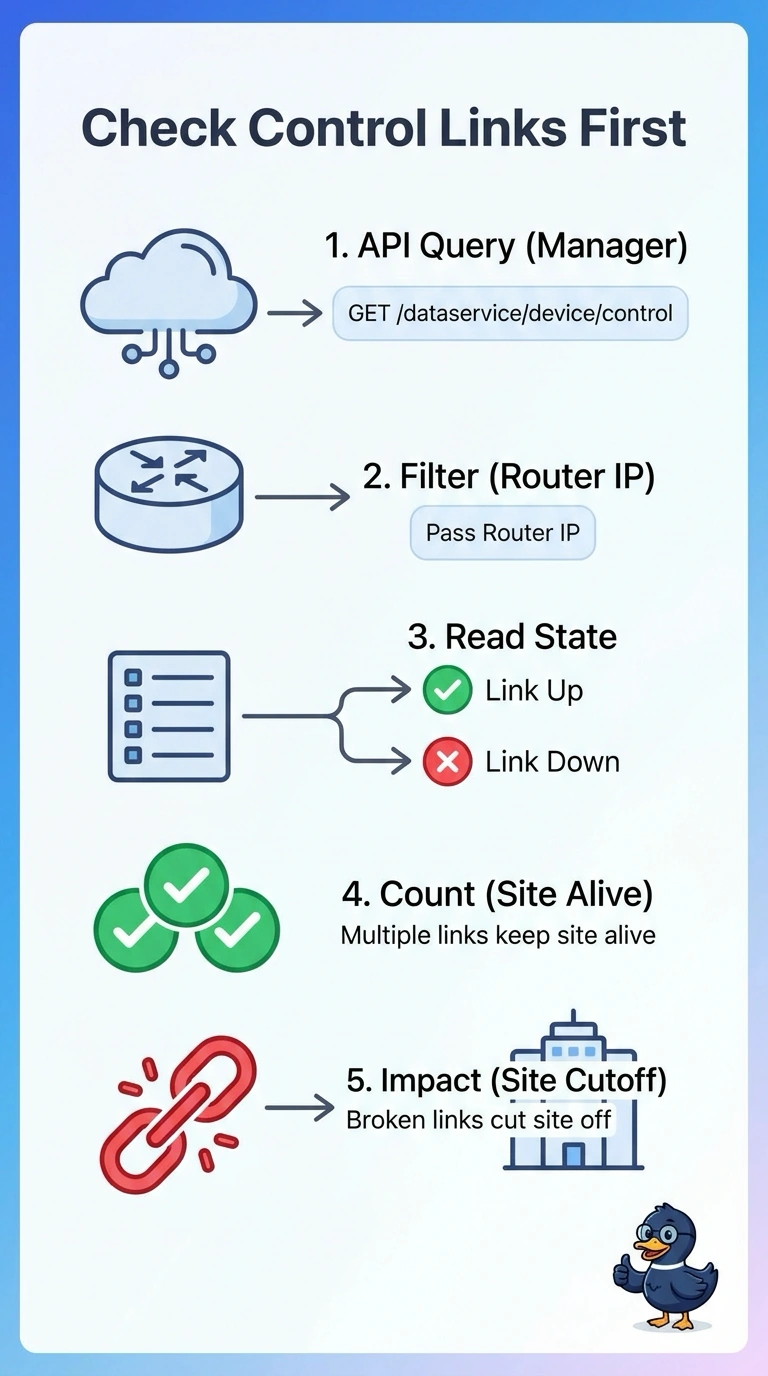
Short Explanation
Control connections are the always-on signalling links between each router and the SD-WAN Manager, and everything else is built on top of them. The control resource returns one row per connection with its state and peer, so you see trouble before you look at forwarding. It's like checking the building's power before debugging a single desk lamp.
Full Explanation
In an SD-WAN overlay, routers establish and keep alive control connections to the controllers and the manager, and only after those are stable do BFD sessions and tunnels form, which makes control state the root of the dependency chain. The data service control resource returns one row per connection for a given device, including connection state, domain and peer address, so you can separate a router that has lost its signalling path from one whose forwarding plane is simply dropping packets. The device resource reports overall reachability only, so it confirms the box is online but says nothing about session health. Tunnel statistics describe the data plane through loss, latency and jitter, which is symptom evidence rather than cause, and the BFD resource covers keep-alive sessions between edges rather than links to the controllers. Exam caveat: endpoint strings and field names are memorisation, so learn which layer each resource serves rather than the literal path. Practical check: run the control query against a quiet router and a troubled one, then compare how many connections report up and which peer they point to.