
A Python script provisions a new branch site in the Meraki dashboard with requests.post, targeting /organizations/123456789/networks so the site gets an MX, an MS and an MR. The payload carries only name, timeZone and tags, and the API answers with a parameter error. Which values must the request supply for the network to be created?
Select an answer to reveal the explanation.
Short Explanation
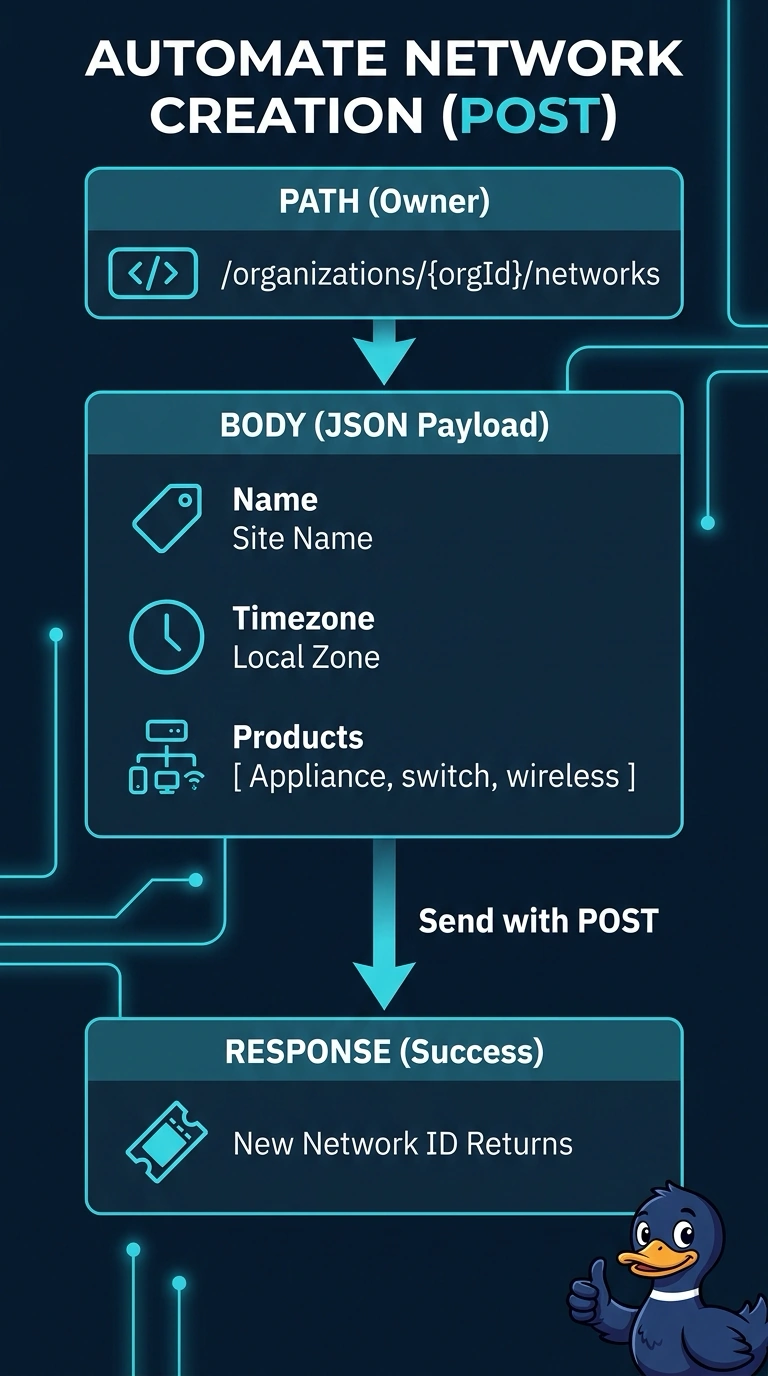
You need the organization ID in the URL, plus the network’s name, local time zone, and productTypes in the JSON body; tags are optional. Think of productTypes as the site’s shopping list—it tells Meraki which device families, such as MX, MS, and MR, the network will support.
Full Explanation
The correct answer is the organization ID in the URL path, plus the network name, local time zone, and product types in the JSON body. The endpoint requires name, timeZone, and productTypes; because this branch will use an MX, an MS, and an MR, the product types must represent appliance, switch, and wireless. The request already supplies the first two body fields, but omits productTypes, explaining the parameter error. The choice that gives only the path ID, name, and time zone describes an incomplete required-field set: it still lacks the products the network supports. The choice that sends all required values as query parameters uses the wrong parameter location; this endpoint expects those fields in the JSON body, not the query string. The choice that supplies an existing network ID to copy settings from confuses configuration cloning with network creation: copyFromNetworkId is optional and cannot replace the required name, time zone, or product types. Exam caveat: the organization ID belongs in the path, not among the required JSON body fields, and tags are optional. Practical check: consult the current endpoint schema for the exact accepted productTypes values, then verify the request body includes all three required fields before sending it.