
A network automation team is building one YANG-based configuration pipeline for BGP neighbor baselines on Cisco IOS XE and Arista EOS. Both vendors advertise OpenConfig support, and the team has verified that its target releases support the same OpenConfig BGP leaves. A later change also sets a DMVPN Phase 3 knob that exists only on Cisco routers. Which model families should the team use for the baseline and for that knob?
Select an answer to reveal the explanation.
Short Explanation
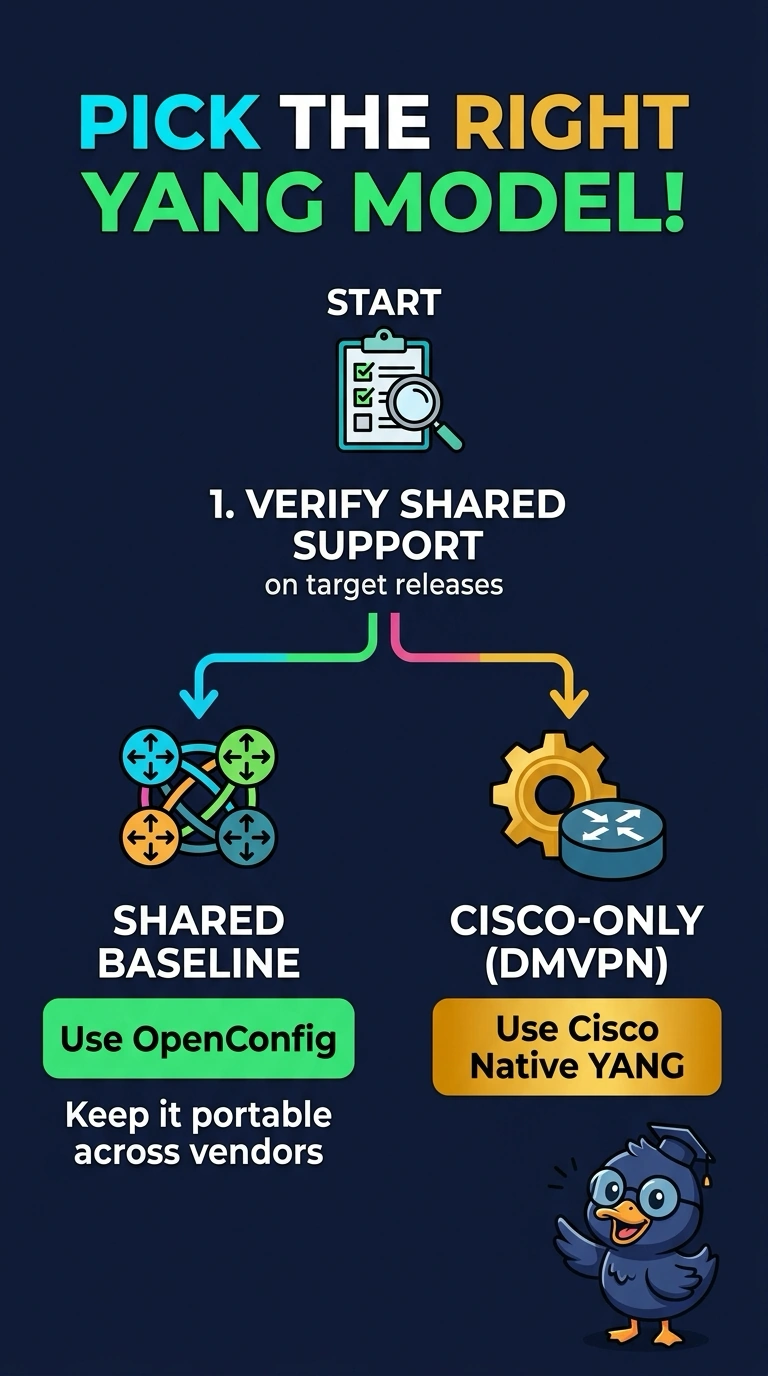
Use OpenConfig for your shared BGP baseline, since both platforms support the same leaves. For the Cisco-only DMVPN knob, use Cisco native YANG—it’s like using a shared road map for common routes and a local map for vendor-specific details.
Full Explanation
OpenConfig is a vendor-neutral model set published by a group of network operators. Its paths can support a shared pipeline when the target platforms and releases implement the relevant model nodes, as stipulated here; support for OpenConfig in general does not guarantee identical coverage across vendors. A DMVPN Phase 3 setting is Cisco-specific, so use the applicable Cisco native model for that change. Cisco native models are not a portable choice for configuring the EOS platform. Mapping the knob to an OpenConfig VPN path is not valid unless that model actually defines the setting. Likewise, RFC publication does not guarantee that every vendor implements a model identically or that it covers proprietary features. Confirm model and leaf availability for the specific software releases before deploying a template.