
A team's automation runs inside an existing web service that speaks HTTP, authenticates with OAuth bearer tokens, and parses responses with a standard JSON library. It must still read and write YANG configuration on branch routers. Which model-driven protocol fits this tooling best?
Select an answer to reveal the explanation.
Short Explanation
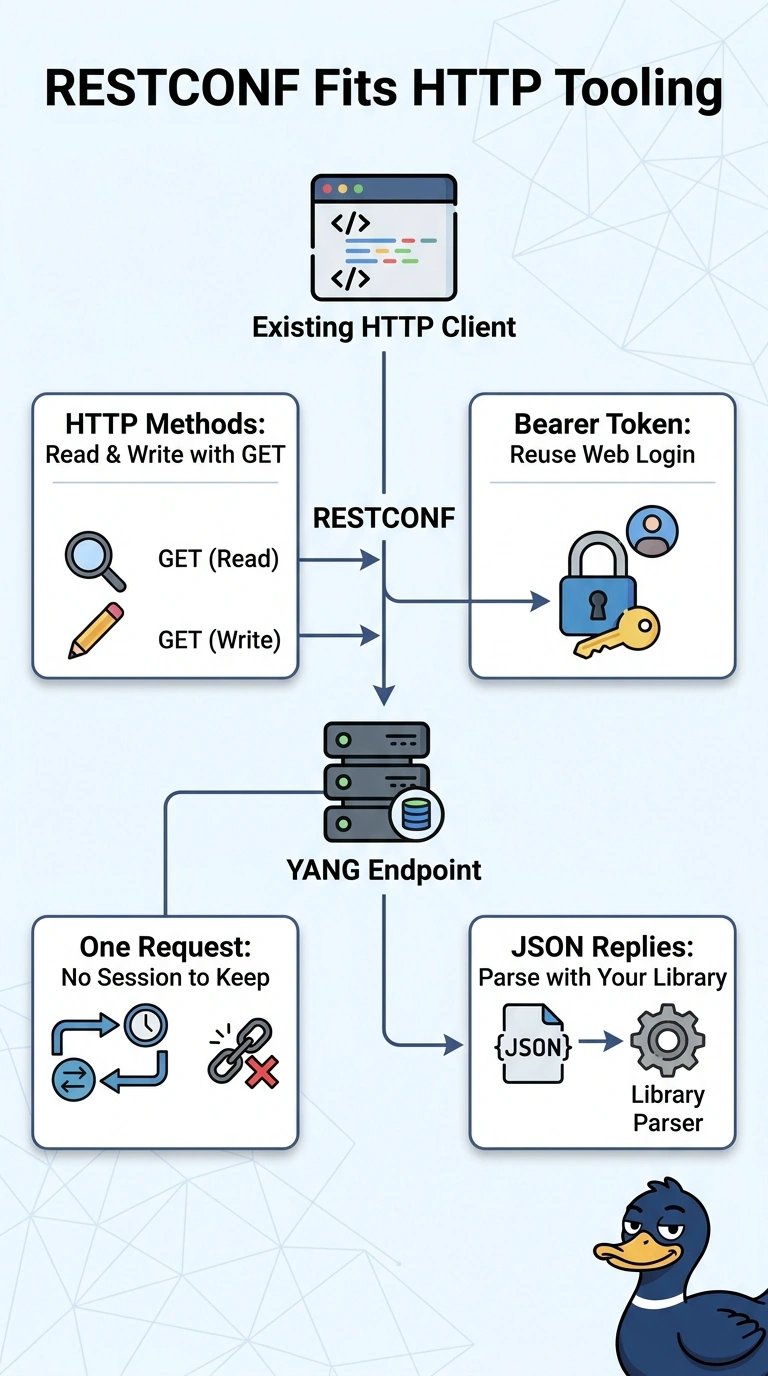
Well chosen: RESTCONF is YANG over plain HTTP, so it drops straight into a service that already holds a token. It's the difference between using your building's mailroom and needing a separate SSH badge. Your bearer tokens and JSON parser work unchanged.
Full Explanation
RESTCONF is the best fit because it exposes YANG-defined configuration resources over HTTP, supports OAuth bearer-token authentication, and can return JSON that the service's existing library can parse. It lets the team work with YANG data without replacing the established HTTP, authentication, or response-processing components. gNMI is a widely used model-driven protocol and can carry YANG data using JSON_IETF encoding; OAuth bearer tokens can also be sent as gRPC metadata. However, it uses gRPC rather than the service's required HTTP interface, so adopting it would require changing the integration transport. RESTCONF with HTTP Basic authentication preserves HTTP and JSON handling, but Basic credentials do not meet the stated OAuth bearer-token requirement. RESTCONF with XML media types preserves the protocol, HTTP transport, and OAuth authentication, but its XML responses do not match the service's stated JSON parsing capability. Exam caveat: a protocol's ability to represent YANG data does not by itself make it compatible with a particular client's transport, authentication scheme, or payload parser. Practical check: verify that the target routers enable RESTCONF and confirm their supported media types and OAuth configuration before implementation.