
An engineer must re-run last Tuesday's 30-minute traffic analysis for one branch router at five-minute granularity using the same time window each time. The SD-WAN Manager statistics resource accepts POST requests whose JSON body carries the time range. Which Monitoring API request design satisfies this statistics query?
Select an answer to reveal the explanation.
Short Explanation
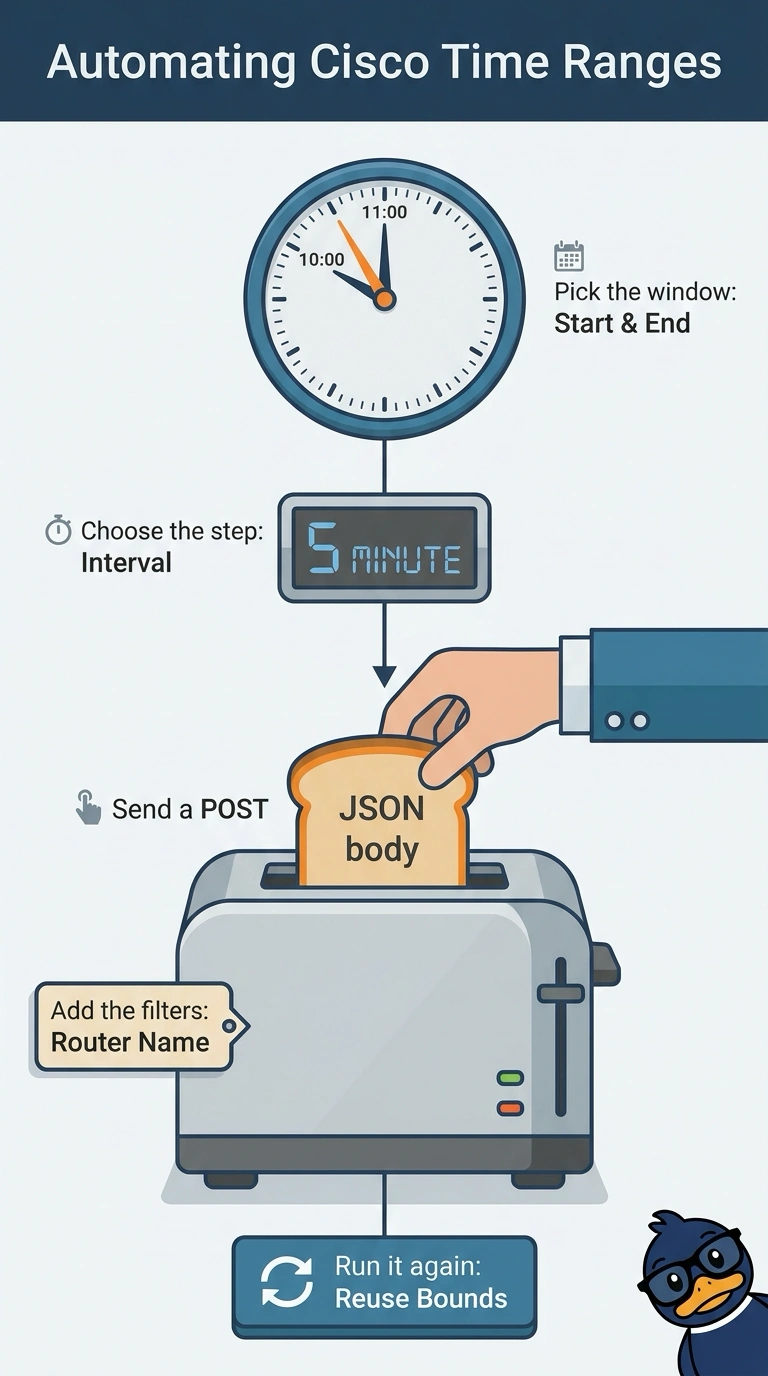
You’ll use a POST request with a JSON body containing explicit start and end timestamps and a five-minute interval, scoped to the one branch router. Fixed timestamps keep each run on last Tuesday’s same 30-minute window, though the underlying data may still change.
Full Explanation
Use a POST request with a JSON body containing explicit start and end timestamps and a five-minute interval, scoped to the one branch router. The fixed timestamps let you re-run last Tuesday’s same 30-minute window instead of querying a period that shifts with the current time; the interval sets the requested sampling granularity. A body with the router and exact timestamps but no interval does not guarantee five-minute results, because a default interval may use a different resolution. A body with the router, a five-minute interval, and a rolling 30-minute window ending now has the desired duration and granularity, but its boundaries change between runs, so it cannot reproduce last Tuesday’s window. A body with exact timestamps and a five-minute interval but targeting all branch routers uses the right time range and granularity at the wrong scope; it does not meet the one-router requirement. Exam caveat: distinguish a fixed historical range from a relative duration, even when both span 30 minutes. Practical check: confirm the request targets the intended router and that its JSON includes the exact start and end timestamps and a five-minute interval before comparing results across runs.