
Intermittent voice jitter keeps reaching the trouble queue: drops on the voice interface last only seconds, and five-minute SNMP polling misses every spike. The voice gateway supports model-driven streaming telemetry. Which telemetry subscription gives the fastest reliable detection of the drops?
Select an answer to reveal the explanation.
Short Explanation
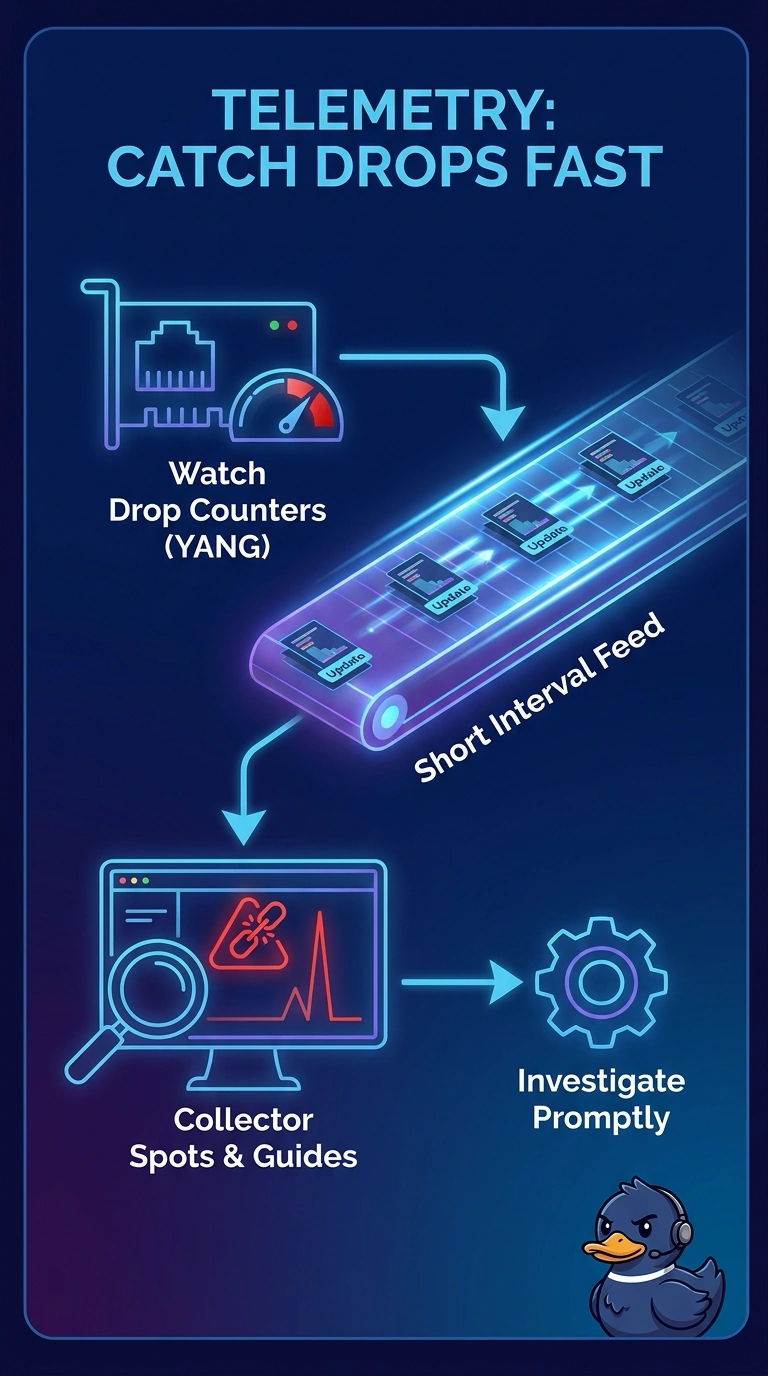
Streaming telemetry lets you subscribe to interface counters and receive updates at the configured sampling interval. A short interval can reveal counter increases much sooner than five-minute polling, though delivery timing also depends on the device and collector. It is like setting a smoke alarm to check more often, rather than reading a dial every few minutes.
Full Explanation
A short-interval YANG interface telemetry subscription is the best fit because the gateway can stream drop-counter updates directly to the collector, avoiding the five-minute polling gap and enabling prompt detection of brief bursts. The sample interval should be short enough to resolve the seconds-long events without creating unnecessary collector or network load. Polling SNMP every 30 seconds is a familiar improvement over five-minute polling, and counter deltas can reveal accumulated drops, but detection still waits for the next poll; a burst may be over before the alert arrives, so it is not the fastest reliable choice here. Streaming the same counters at one-minute intervals uses the right telemetry mechanism and metric, but its sampling cadence is too coarse for events lasting only seconds and can delay or obscure their detection. Streaming operational-state changes is also a standard way to detect link failures promptly, but voice drops can occur while the interface remains up, so link transitions do not measure the stated fault. Exam caveat: streaming telemetry is not automatically event-driven; its sample or push cadence and the subscribed YANG path determine what can be detected. Practical check: verify that the subscription exposes the correct interface drop counters, confirm the effective interval at the collector, and test it with a brief controlled drop event.