
During a change window you review a small Python snippet that summarizes show ip interface brief data across three switches, each returning Gi1/0/1 to Gi1/0/4, so twelve records share four repeated names. Nine state values are up, two are down, one is administratively down. The script appends r["int"] to up when r["state"] == "up" and to down otherwise. What does each list hold when the loop finishes?
Select an answer to reveal the explanation.
Short Explanation
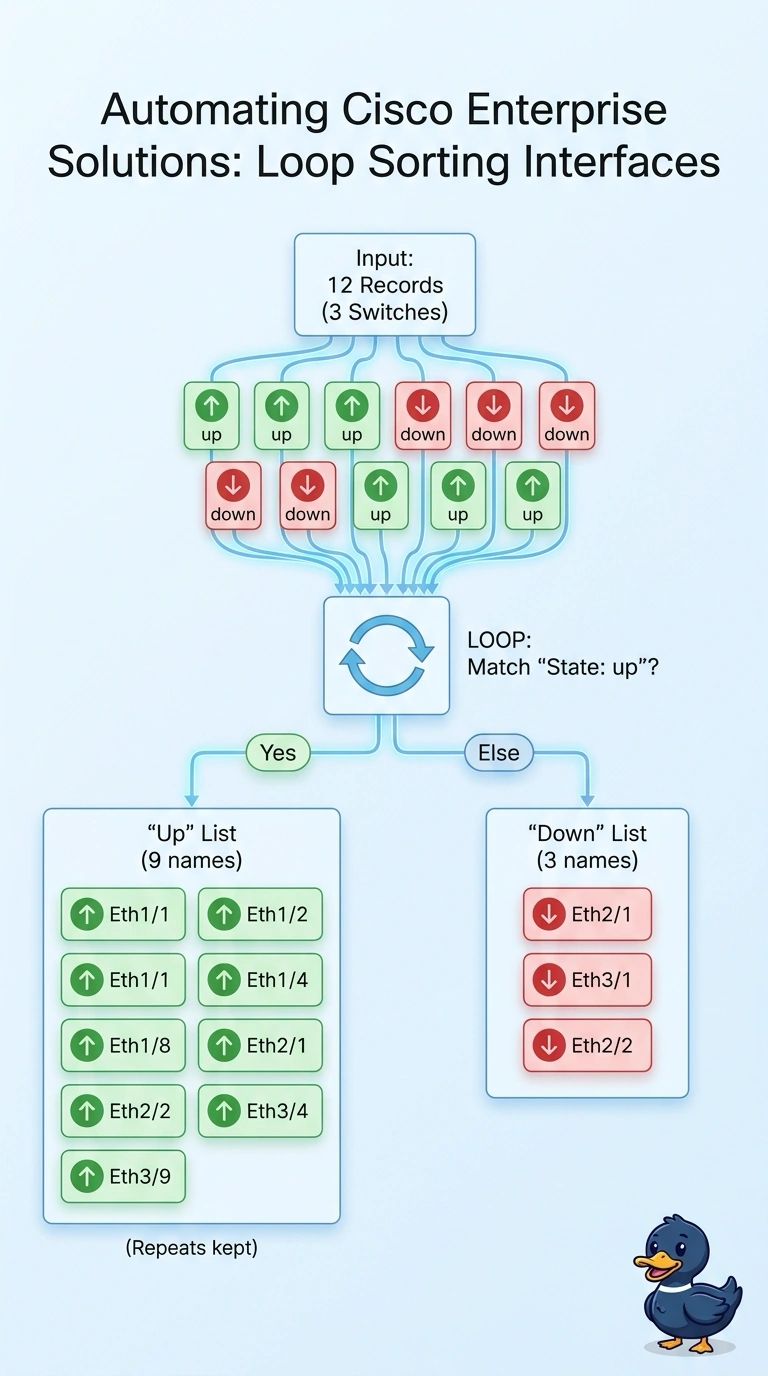
Your loop works like a sorting gate: every record passes through once and lands in exactly one list. The fall-through branch swallows the administratively down record too, and append keeps each repeated name because a list won't dedupe them for you.
Full Explanation
The loop visits each of the twelve records exactly once, and the conditional sends every record to exactly one list. The equality test on the state value routes the nine up records into the first list, while the fall-through branch collects everything that fails the test, which is the two down records plus the administratively down record, giving three. Because append always adds a fresh element, the four interface names repeated across the three chassis are all retained, so the first list genuinely holds nine entries rather than four distinct names. The uniqueness reasoning fails because Python lists keep duplicates by design, the partial-match reasoning fails because it tests only the literal down string instead of relying on fall-through handling, and the field-mixing reasoning fails because the script appends the interface key rather than the state key. Exam caveat: a question may swap the appended key or add a second condition, so read the comparison itself before you trust any count. A quick practical check is to paste two sample records into the interpreter and print both list lengths.