
A logistics firm with 60 SD-WAN sites must attach a revised device template to five pilot routers via Python during a maintenance window. Requirements demand staged attach, feature input per device, and polling until push succeeds before closing the ticket. Which attaching a device template and monitoring the push task sequence should the script implement for the pilot rollout?
Select an answer to reveal the explanation.
Short Explanation
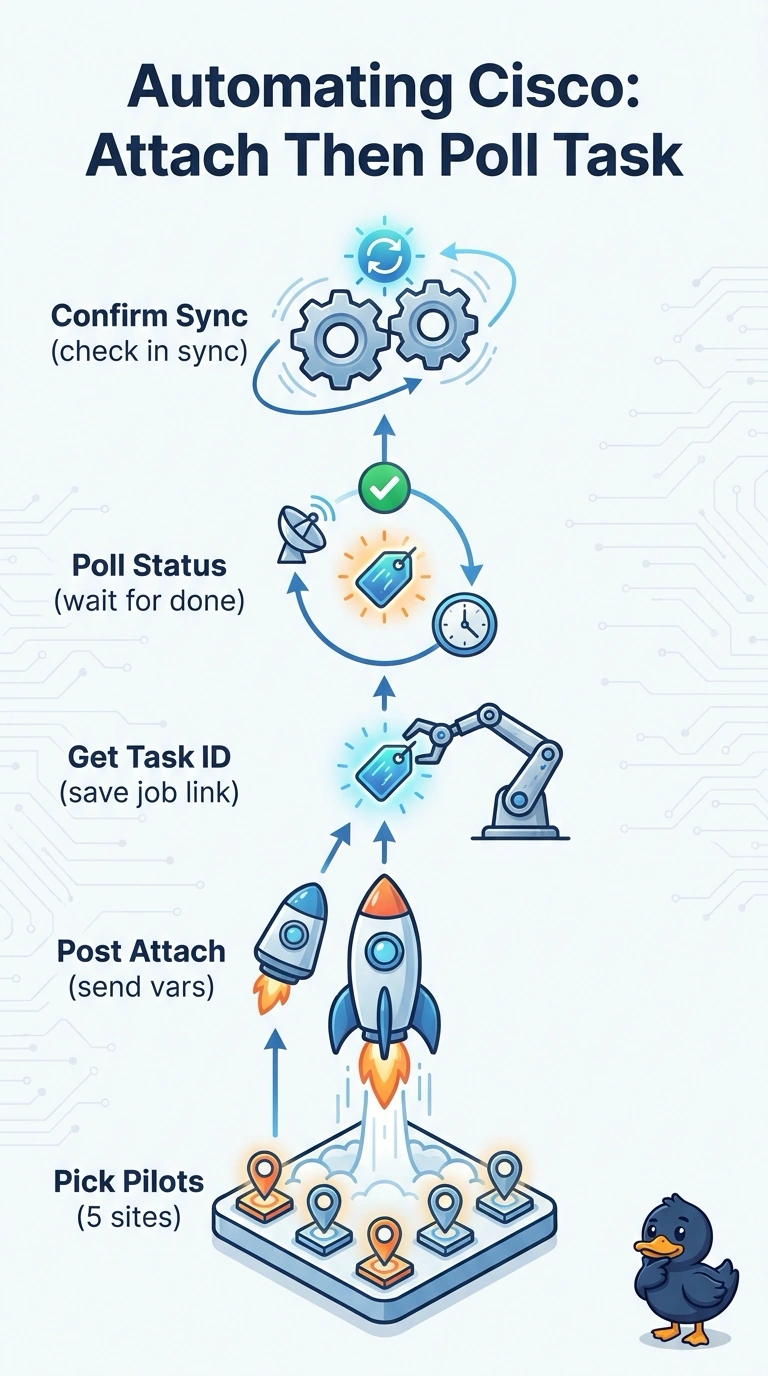
Treat each staged push like a tracked delivery: your script posts the template attach with feature inputs for each device, then polls the push task ID until it succeeds. Polling confirms each pilot router received its configuration before you close the ticket.
Full Explanation
The correct workflow keeps the change within the five-router pilot, supplies each router’s feature inputs as device variables in the attach request, and polls the returned push task ID until the task reports success. This verifies completion rather than treating request acceptance as proof that the configuration was pushed, so the ticket can remain open until the required outcome is confirmed. Subscribing to task events is a valid way to observe asynchronous jobs, but it does not meet the stated requirement to poll; an event subscription can also miss notifications if delivery or reconnection handling fails. Attaching all 60 sites with per-device variables and polling their tasks provides task-level confirmation, but it expands the rollout beyond the five designated pilot routers and removes the staged pilot boundary. Using shared feature values while attaching and polling each pilot preserves the cohort and task monitoring, but it fails to provide the required feature input per device; devices with differing settings could receive incorrect values or fail validation. Exam caveat: API acceptance, task creation, and task success are distinct states, and a task may report intermediate, partial, or failed status before completion. Practical check: confirm the request targets only the five pilot device IDs, inspect each device’s submitted variables, and verify every associated task reaches a documented success state before closing the ticket.