
A service provider must push standardized BGP, NTP and logging settings to 40 SD-WAN edge routers while each site supplies its own router ID and site name, and the shared standard has to stay as one reusable definition. The team drives SD-WAN Manager from Python. Which template API approach should the script use?
Select an answer to reveal the explanation.
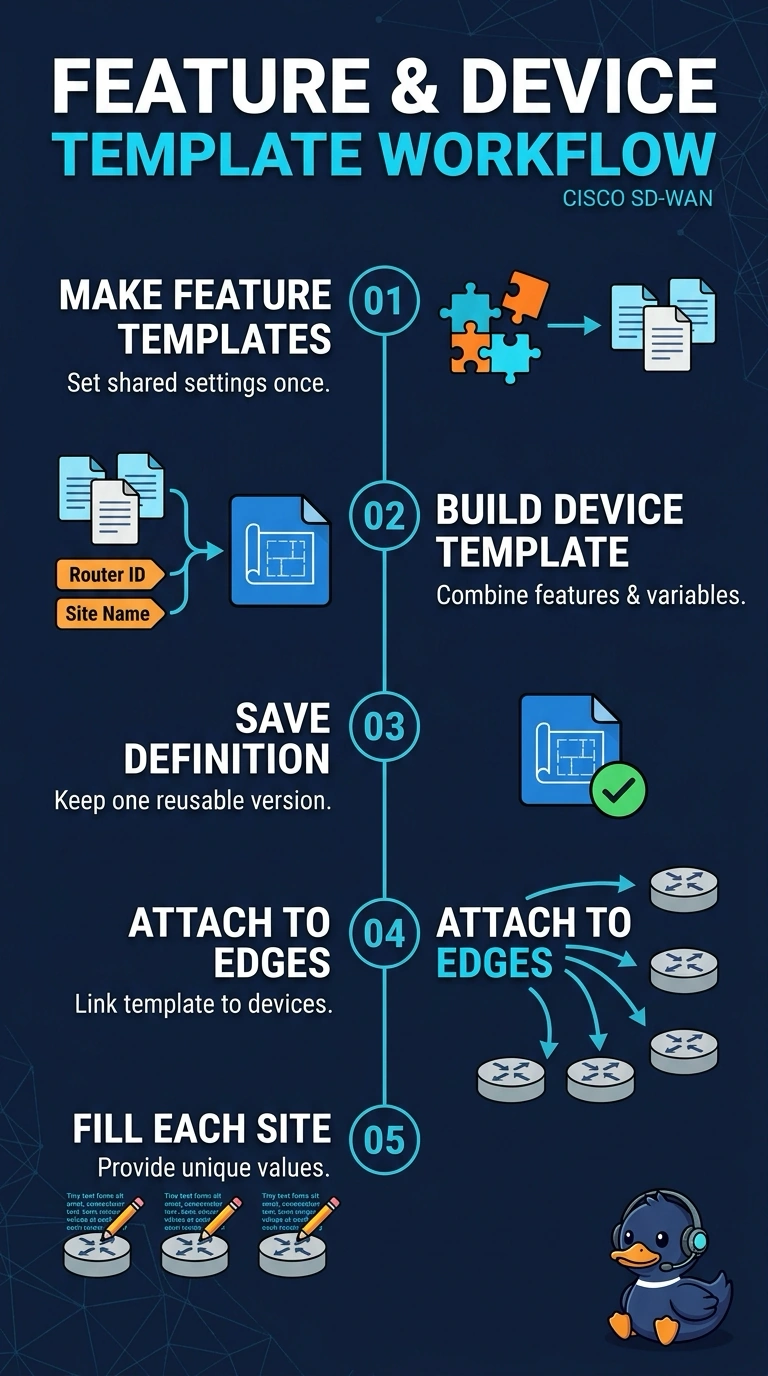
Short Explanation
You can treat feature templates like reusable recipe cards for the shared BGP, NTP, and logging settings. You’ll combine them in a device template with each site’s router ID and name, then attach it to every edge so you keep one standard while supplying site-specific values.
Full Explanation
SD-WAN Manager uses feature templates for reusable configuration and device templates to combine feature templates and define device-specific variables. Build the shared BGP, NTP and logging settings as feature templates, include them in a device template with router ID and site name variables, and attach that device template to the edges. Pushing each device's full configuration directly from Python does not keep the standard as one reusable template definition. A static CLI template with hard-coded values cannot provide the different site identities. Separate variable-free templates could encode the different values, but would scatter the standard across forty objects instead of keeping one reusable definition. Payload fields and naming rules can differ between SD-WAN Manager releases, so confirm the current schema in the documentation. A lab check can verify that the attachment prompts for the router ID and site name for each device.