
A service provider is onboarding 40 new vEdge routers for a retail customer, and the team will drive SD-WAN Manager from Python so a shared BGP policy stays centrally editable and later edits reach the devices. Which sequence of Configuration API operations puts these devices under feature template control?
Select an answer to reveal the explanation.
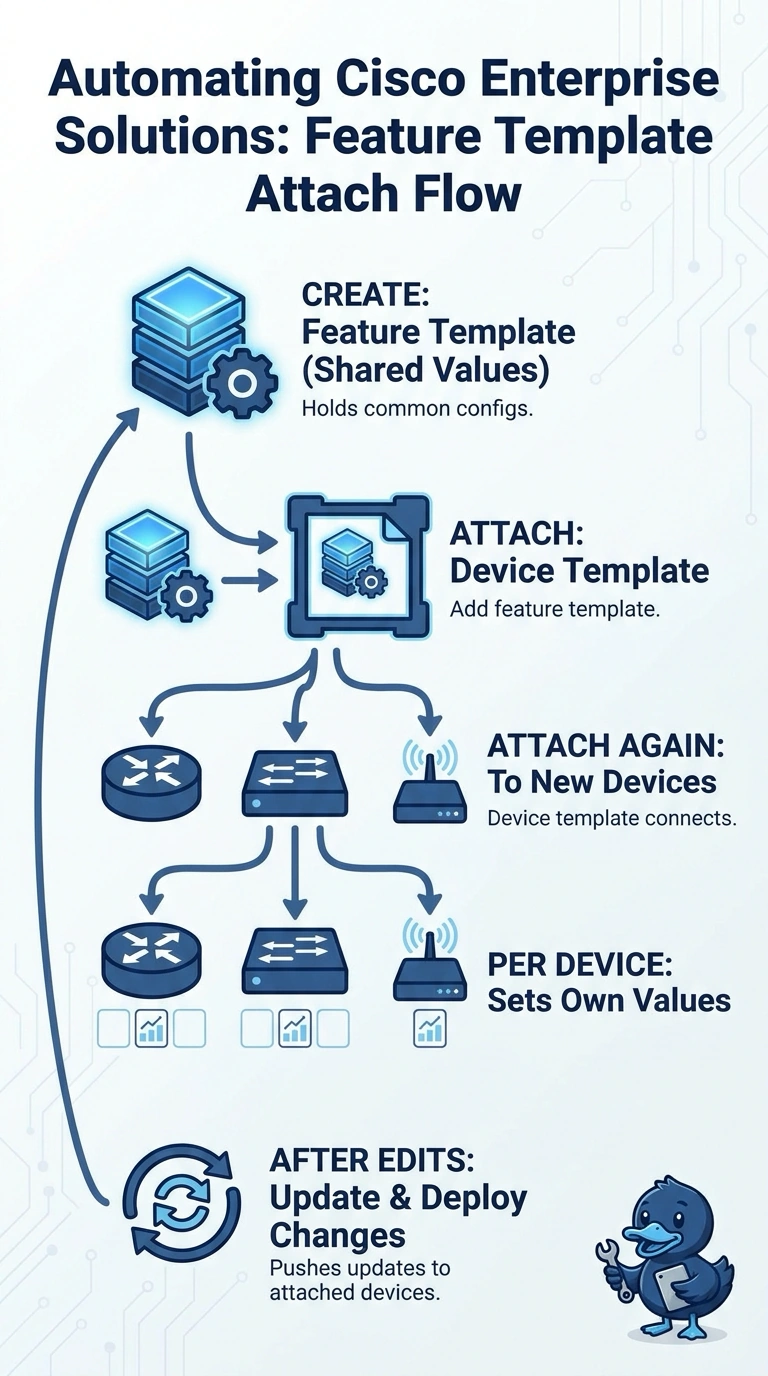
Short Explanation
The API mirrors how the manager layers configuration, so you'll build in the same order: a shared definition, a template that binds it, then the devices. Skipping the device template is like skipping the folder and handing loose pages to forty people, so the structure falls apart.
Full Explanation
SD-WAN Manager, which older material still calls vManage, organizes configuration as a layered workflow, and its Configuration API mirrors that workflow. A feature template holds the shared definition of a feature such as BGP, with placeholders for values that differ per router, so it is created first. That feature template is then attached to a device template, which groups feature templates for a device type, and the device template is attached to the devices. Attaching the feature template straight to a router skips a required layer. To apply later template changes to attached devices, update the device template and deploy the resulting configuration to those devices; they do not simply pick up the change automatically. Pushing BGP through CLI template operations uses a different workflow and does not put the devices under feature template control. Exam caveat: API paths and payload fields differ between releases, so confirm them in your version's documentation. Practical check: after attaching, open device template status in the GUI and confirm every router shows as attached.