
A team must standardise OSPF hello and dead timers on twelve IOS XE edges managed by SD-WAN Manager. The engineer builds one feature template in JSON and wants site-specific addresses kept as variables in the shared template. Which sequence of template configuration API operations should the Python script run to roll this out safely?
Select an answer to reveal the explanation.
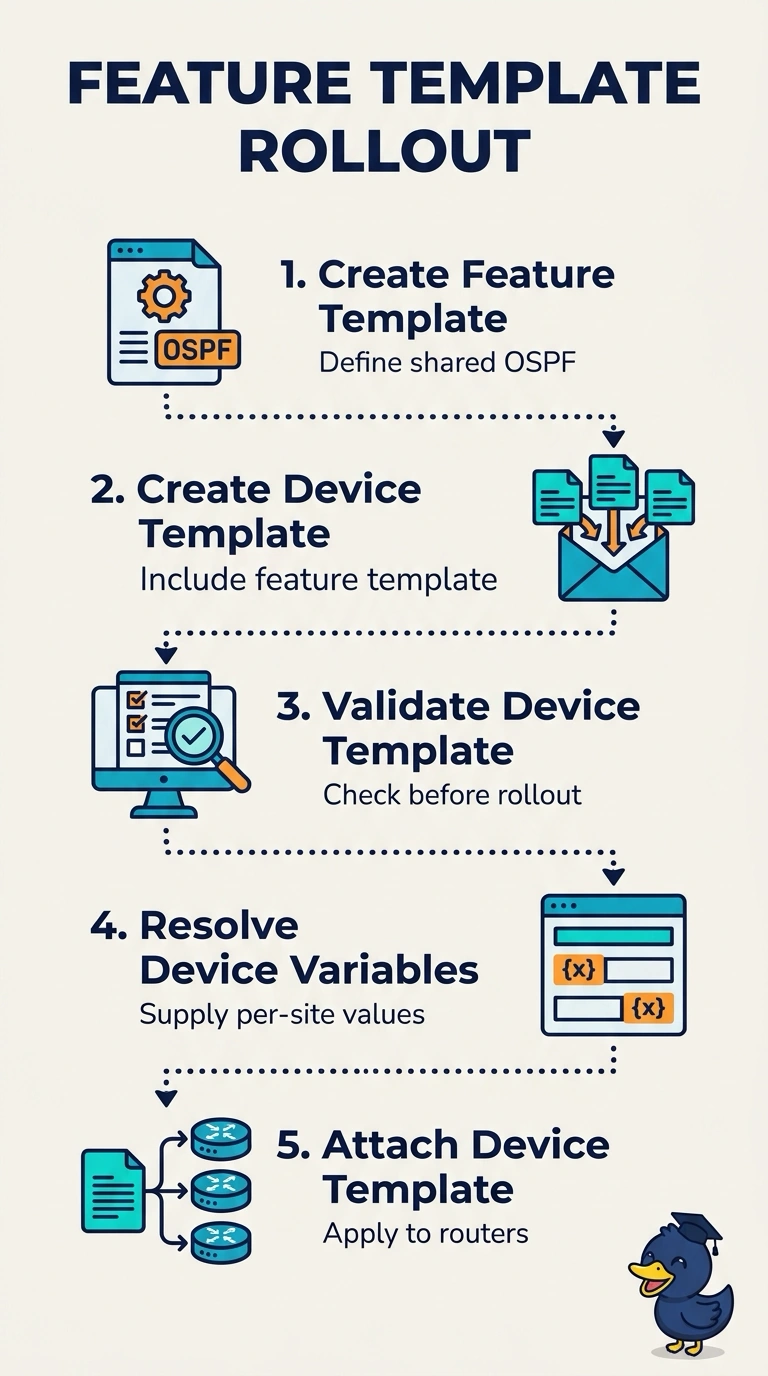
Short Explanation
Your feature template holds the shared OSPF settings, while a device template bundles them for deployment and keeps site-specific values separate. Build and validate that device template, resolve each device’s variables, then attach it to roll out safely.
Full Explanation
In SD-WAN Manager, a feature template defines reusable feature settings, while a device template combines feature templates for deployment to devices. Create the feature template with the shared OSPF settings and address placeholders, include it in a device template, validate the composed device template, resolve the device-specific variable values, and then attach the device template. This preserves the shared configuration while supplying each edge’s addresses separately. Attaching the feature template directly to routers bypasses the device-template deployment workflow, and validating the device template only afterward means deployment was attempted before the composed configuration was checked. Creating and validating a feature template but attaching it directly to routers also skips the device template needed to bundle settings and deploy variables. A CLI template is configuration text, not the structured feature-template configuration required for this workflow; resolving values and using a device-template endpoint does not make it a feature template. Exact API endpoints and request formats can vary by SD-WAN Manager release, so check the documentation for the deployed version. As a practical safeguard, validate the device template, attach it to one edge, and check the result before proceeding with the remaining devices.