
A campus network of 40 access switches across six buildings needs a new VLAN and QoS policy, and port roles differ by building so identical CLI lines will not fit. The team wants the policy defined centrally, configured with the required site-specific differences, and applied automatically, with compliance status refreshed automatically rather than requiring a manually launched check. Which approach best meets these requirements?
Select an answer to reveal the explanation.
Short Explanation
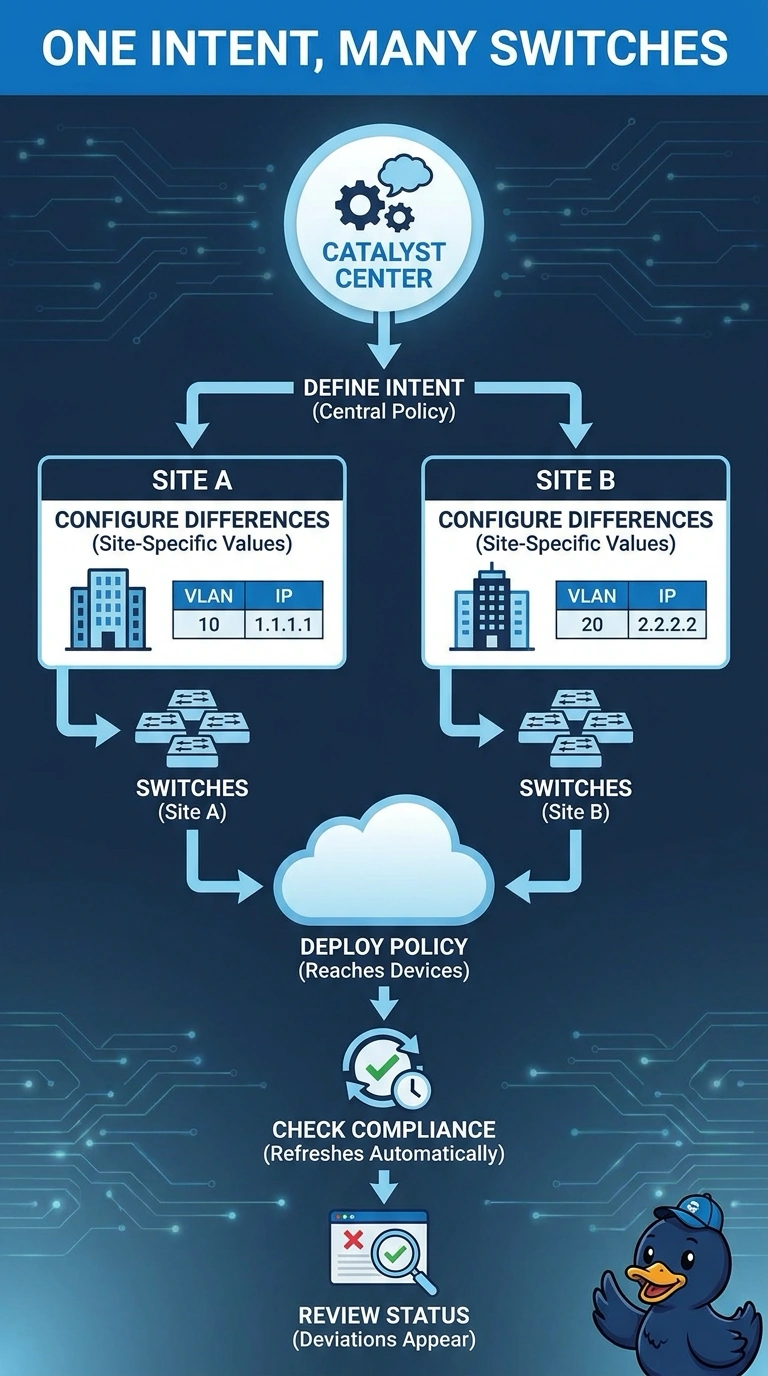
Use Catalyst Center as your policy hub: you’ll define the intent, account for each site’s port-role differences, and deploy it across the switches—like one recipe with local adjustments. Compliance status refreshes automatically, though not instantly, unlike scripts or playbooks whose checks update only when you run them.
Full Explanation
The Catalyst Center intent-based approach is the best fit because it centralizes the VLAN and QoS policy, supports site-specific configuration for differing port roles, automates deployment, and provides automatically refreshed compliance status. Ansible with per-building variables is a valid automation pattern and can deploy configuration automatically, but separating compliance into an audit playbook that an engineer must launch leaves the required status refresh dependent on manual action. Defining and scheduling the policy checks in Catalyst Center addresses ongoing compliance visibility, but requiring an engineer to initiate each deployment does not meet the requirement for automatic application. A single uniform Catalyst Center policy can be centrally managed, deployed, and monitored, but it cannot represent the stated building-level differences in port roles; applying identical settings risks configuring some ports incorrectly. Exam caveat: distinguish scheduled compliance evaluation from deployment—automating one does not necessarily automate the other. Practical check: before rollout, verify that the design maps each building’s port roles to the intended VLAN and QoS settings, that deployment is enabled for the target sites, and that compliance data updates on its configured schedule without a manually started check.