
An engineer must deploy a Catalyst Center template version to one access switch. Its variables take the syslog server address and the login banner from a YAML file, and the script has to report whether the switch finished the change. Which API flow confirms that template deployment?
Select an answer to reveal the explanation.
Short Explanation
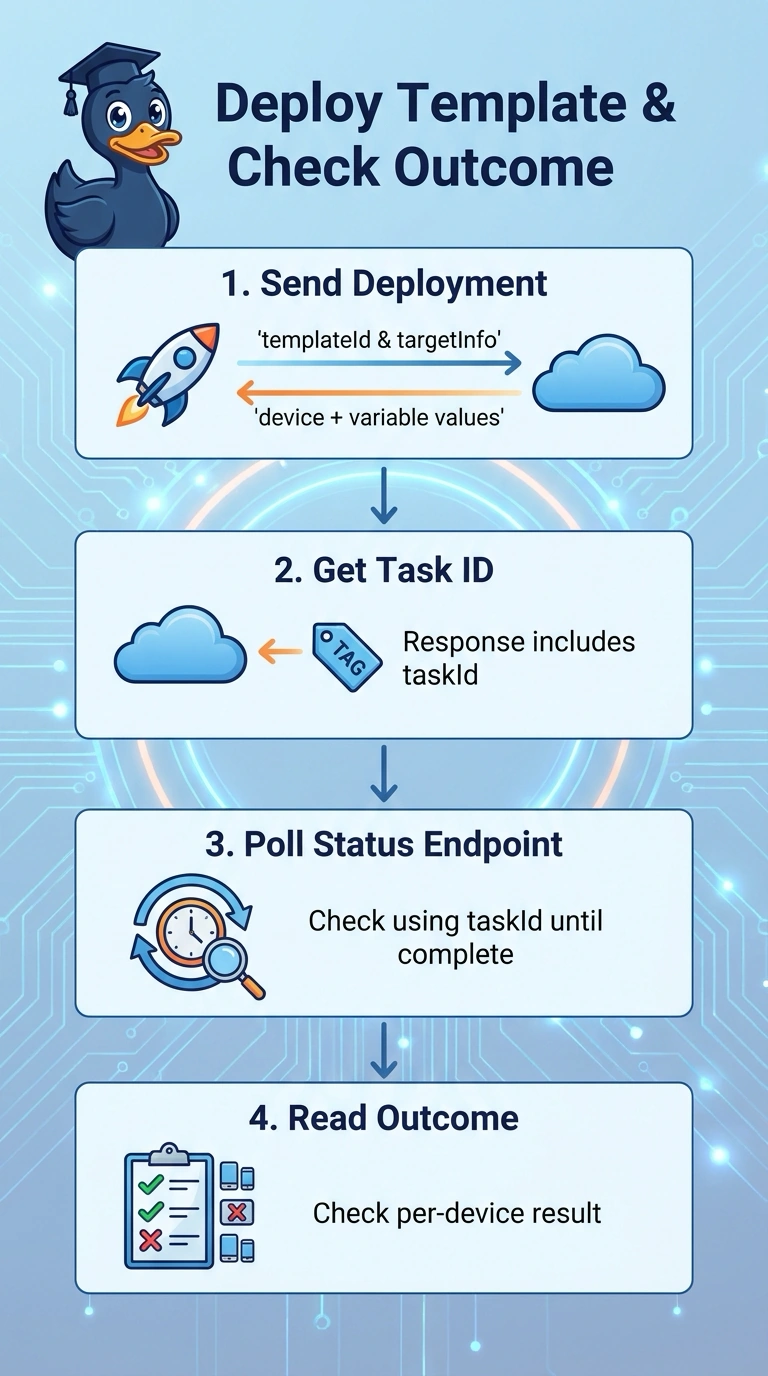
You can include the template ID, target switch details, and YAML variable values in the deployment request, then poll the task status endpoint with the returned task ID. Think of that ID as a receipt: it lets you check whether the switch finished, since a 200 response alone doesn’t confirm completion.
Full Explanation
Deploying a template version through Catalyst Center (formerly DNA Center) is asynchronous. Send the template ID and targetInfo identifying the switch, along with a params map containing the YAML-provided values, such as the syslog server address and login banner. The response returns a task ID; poll the task status endpoint with that ID to learn whether the deployment completed and succeeded on the device. An HTTP 200 response indicates that the request was accepted, not that the switch finished the change. Rendering the commands in Python and pushing them over NETCONF may change the device configuration, but it does not deploy the template version through Catalyst Center or provide its deployment task status. Sending the device target without the YAML values leaves the requested template variables unfilled and may cause rendering or deployment to fail. Exam caveat: a template must be saved as a new version before you deploy it, so create a new version after any edit. Practical check: keep polling the task endpoint until the task completes, then inspect the per-device outcome to confirm the switch’s result.