
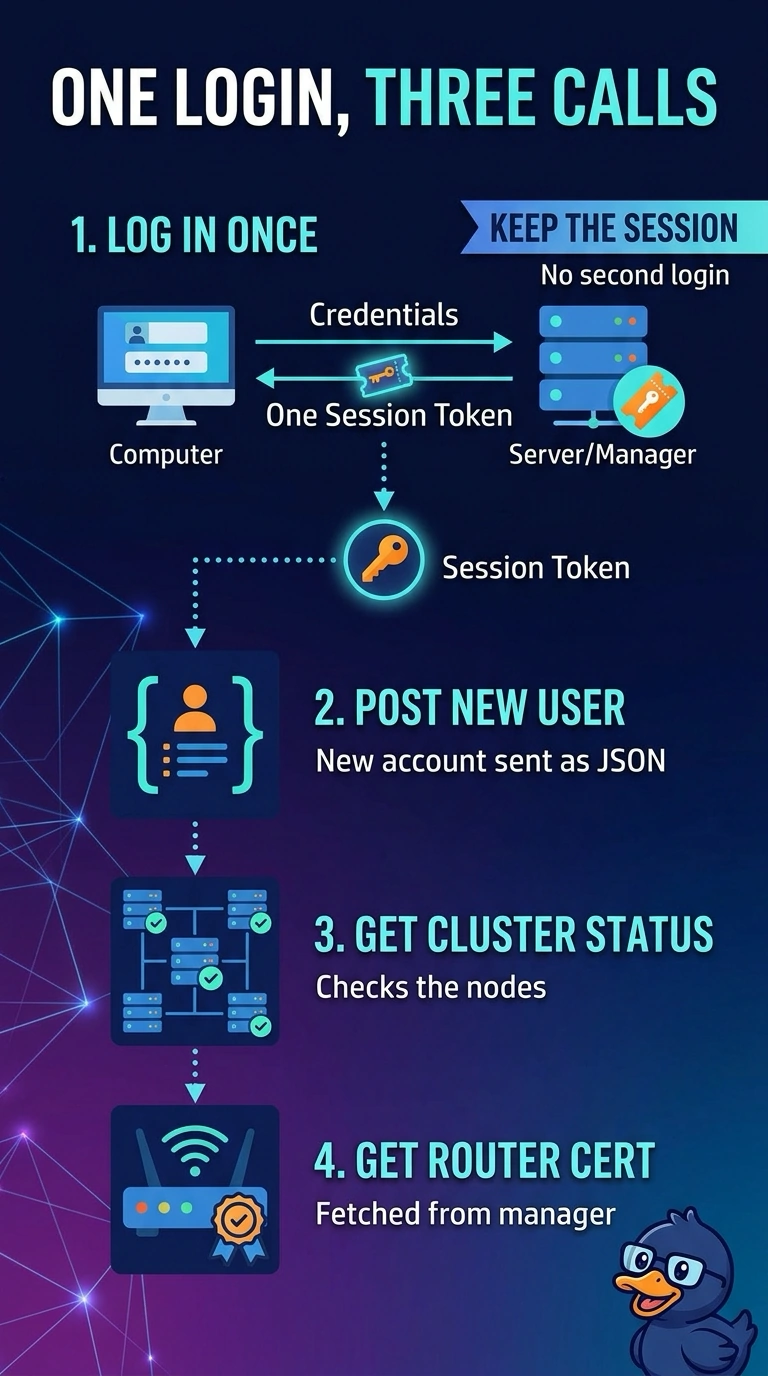
A CI job must authenticate to SD-WAN Manager exactly once per run, create a limited admin account with a JSON body, read controller cluster status, and fetch the device certificate that the manager issued for a new edge router. Which Administration API request sequence should the script send?
Select an answer to reveal the explanation.
Short Explanation
SD-WAN Manager wants a single login that hands you a token to reuse, and creating an account is a POST to the user resource. Every read stays a GET, all riding that same session, so the job authenticates exactly once. It's the session token carrying the whole run.
Full Explanation
The required sequence is to establish one authenticated session with SD-WAN Manager, use that session to create the limited admin account with a JSON request body, and then use it for both reads: cluster status and the certificate issued by the manager. This keeps authentication to one login per run while ensuring each operation targets the correct resource and uses the expected representation. The form-data variant preserves the session and requests but fails the explicit JSON-body requirement; form encoding is common for web forms, yet it does not satisfy an API contract that expects JSON. The PUT variant also preserves the session, JSON payload, and reads, but uses the wrong creation method: the specified user-creation operation is a POST, whereas PUT is commonly used for replacement or idempotent creation at a known resource URI. The enterprise-CA variant correctly creates the account and reads cluster status through the manager session, but it retrieves a certificate from the wrong issuer; the requirement is specifically for the certificate the manager issued to the new router. Exam caveat: HTTP verbs and accepted body formats are API-contract details, not universal rules inferred solely from REST conventions. Practical check: confirm the endpoint, method, content type, session-token handling, and certificate source in the target Manager version’s API documentation or API explorer before scripting.