
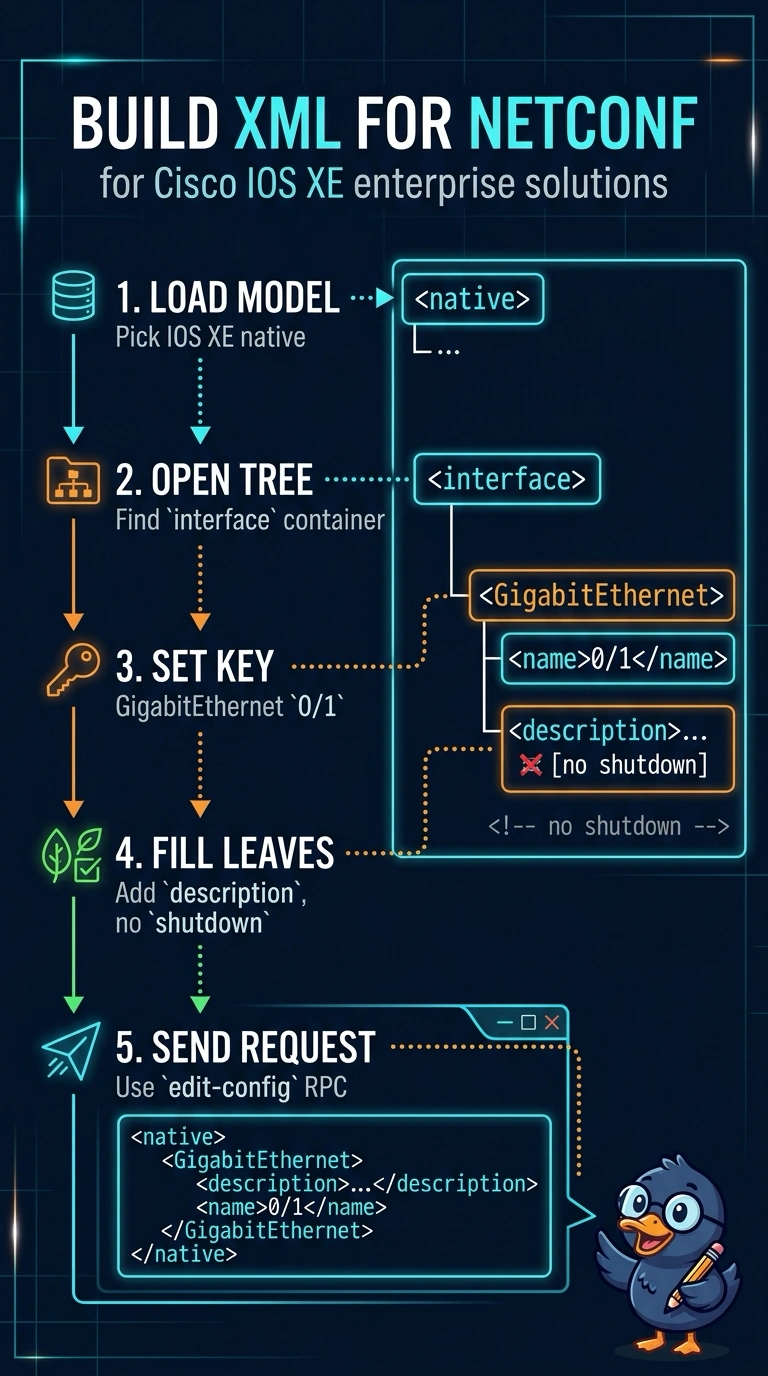
An engineer prepares a NETCONF edit-config request for a Cisco IOS XE router using YANG Suite. In the tool they load the native model and build a message that gives GigabitEthernet0/1 the description uplink-to-core while leaving it administratively enabled. Which XML structure correctly expresses the interface list entry for the edit-config request?
Select an answer to reveal the explanation.
Short Explanation
Your interface entry needs the name key set to 0/1, like a label that identifies the right list item. Add the description and leave out the shutdown leaf so the interface stays enabled.
Full Explanation
The correct structure represents the Cisco native model’s interface list entry with the required key value, 0/1, and supplies the description leaf without a shutdown leaf. In this model, shutdown is the configuration that administratively disables the interface; omitting it preserves the requested enabled state. Using GigabitEthernet0/1 as the name key is a plausible interface identifier in some contexts, but it does not match the key value required for this native-model list entry. Adding shutdown would explicitly disable the port, contradicting the stated administrative state. Marking description with nc:operation="remove" is a valid NETCONF edit operation for deleting an existing leaf, but it removes the description rather than configuring uplink-to-core. Exam caveat: NETCONF edit-config behavior can depend on the selected datastore and operation attributes, so do not assume that an omitted leaf always resets an existing value; merge is commonly used to change only the supplied configuration. Practical check: inspect the loaded YANG model’s list key and leaf names in YANG Suite, then validate the serialized XML and confirm the target interface’s resulting configuration after the edit.