
Two automation scripts on one jump host need different versions of the same Python library, and the system tools' packages must stay untouched. Which statement correctly describes what creating a virtual environment isolates?
Select an answer to reveal the explanation.
Short Explanation
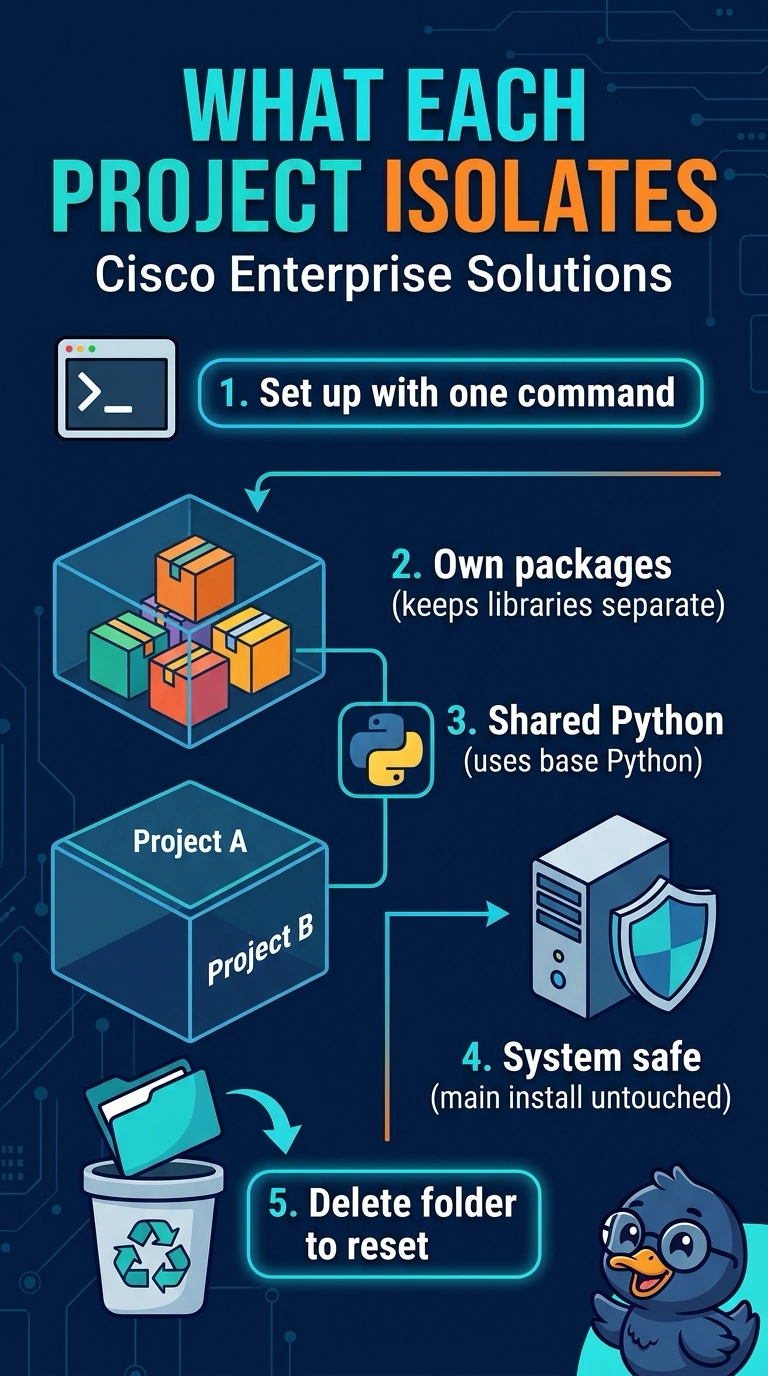
By default, a virtual environment gives your project its own site-packages folder while the system install stays untouched. It's like a labeled lunchbox that keeps your snacks apart from the office fridge. Two scripts can then install different versions of the same library without fighting over them.
Full Explanation
A standard Python virtual environment gives a project its own package-installation location, so two environments can hold different versions of the same library without changing the system interpreter’s packages. This is the relevant isolation for the scenario; it does not mean the environment is a separate machine or a complete operating-system sandbox. Installing with pip --user is a common way to avoid modifying system packages, but the user-level package directory is shared, so it does not provide separate dependency versions for the two projects. The --system-site-packages setting is a valid environment configuration, but it deliberately makes system-installed packages visible inside the environment; that is an exception to the default isolation behavior, not what a default environment isolates. pipx is commonly used to install command-line applications into separate environments, but it is not a general mechanism for managing dependencies for arbitrary project scripts. Exam caveat: a virtual environment usually uses the base interpreter rather than copying a wholly independent Python runtime, and its isolation can be weakened by configuration. Practical check: activate each environment, compare sys.prefix with sys.base_prefix, and inspect sys.path or run python -m pip show <package> to confirm which installation is being used.