
A network engineer has saved a CLI template in Catalyst Center for six branch access switches and wants to push it from a Python script that already finds the devices by management address. The change window closes soon, so the script must send the template with its parameters and then confirm each switch finished successfully. Which Template API call sequence proves the deployment completed?
Select an answer to reveal the explanation.
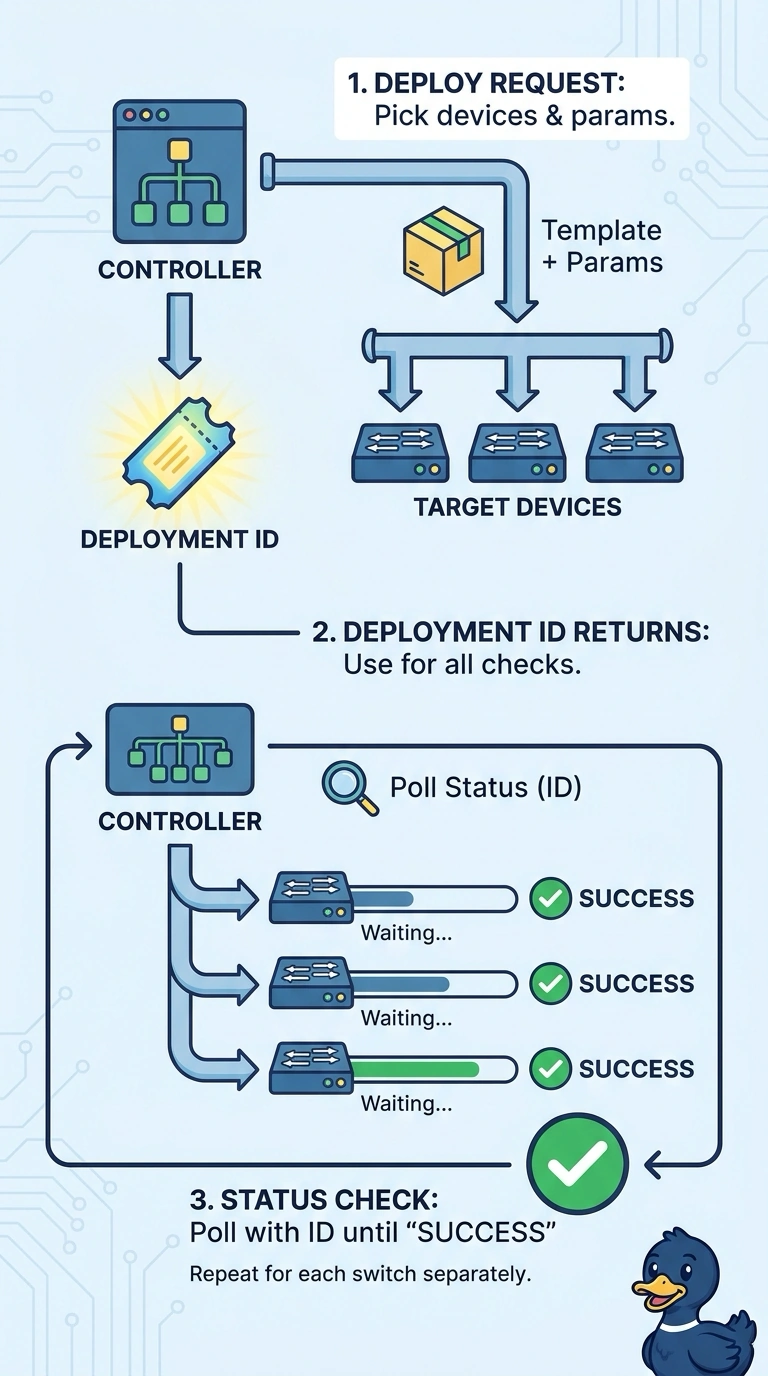
Short Explanation
You’re on the right track: send the template with the target device IDs and parameter values, then poll the deployment-status endpoint using the deployment ID returned by the API. Before closing the change, confirm that every switch reports success; a configuration check, aggregate completion, or terminal state alone doesn’t prove that outcome.
Full Explanation
To prove the deployment succeeded, send the saved template deployment request with the target device IDs and parameter values, then poll the deployment-status endpoint and verify that every device reports success. Deployment submission typically starts asynchronous work, so the response to the request may confirm acceptance without confirming that configuration reached all six switches. Inspecting each switch’s running configuration is a useful operational check, but it does not establish that this deployment completed successfully: the expected commands may already have been present, and a configuration read does not report the deployment’s per-device outcome. Polling only the deployment job’s aggregate status can hide a partial failure if the overall job reports completion while one switch failed; verify each device’s result. Polling each device until it reaches a terminal state is also insufficient, because failure is terminal too; every device must report success. Exam caveat: distinguish a request being accepted, a job being completed, and a device reporting successful deployment, and follow the API’s documented status meanings. Practical check: use the deployment identifier to correlate the results with all six target IDs, confirm success for each, and investigate missing or failed results before declaring the change complete.