
A campus WAN edge carries voice, interactive video, and bulk data with recurring congestion at peak hours causing voice choppiness and video freezes while bulk transfers fill buffers. Which queuing and congestion-avoidance design best protects real-time media while fairly sharing remaining bandwidth?
Select an answer to reveal the explanation.
Short Explanation
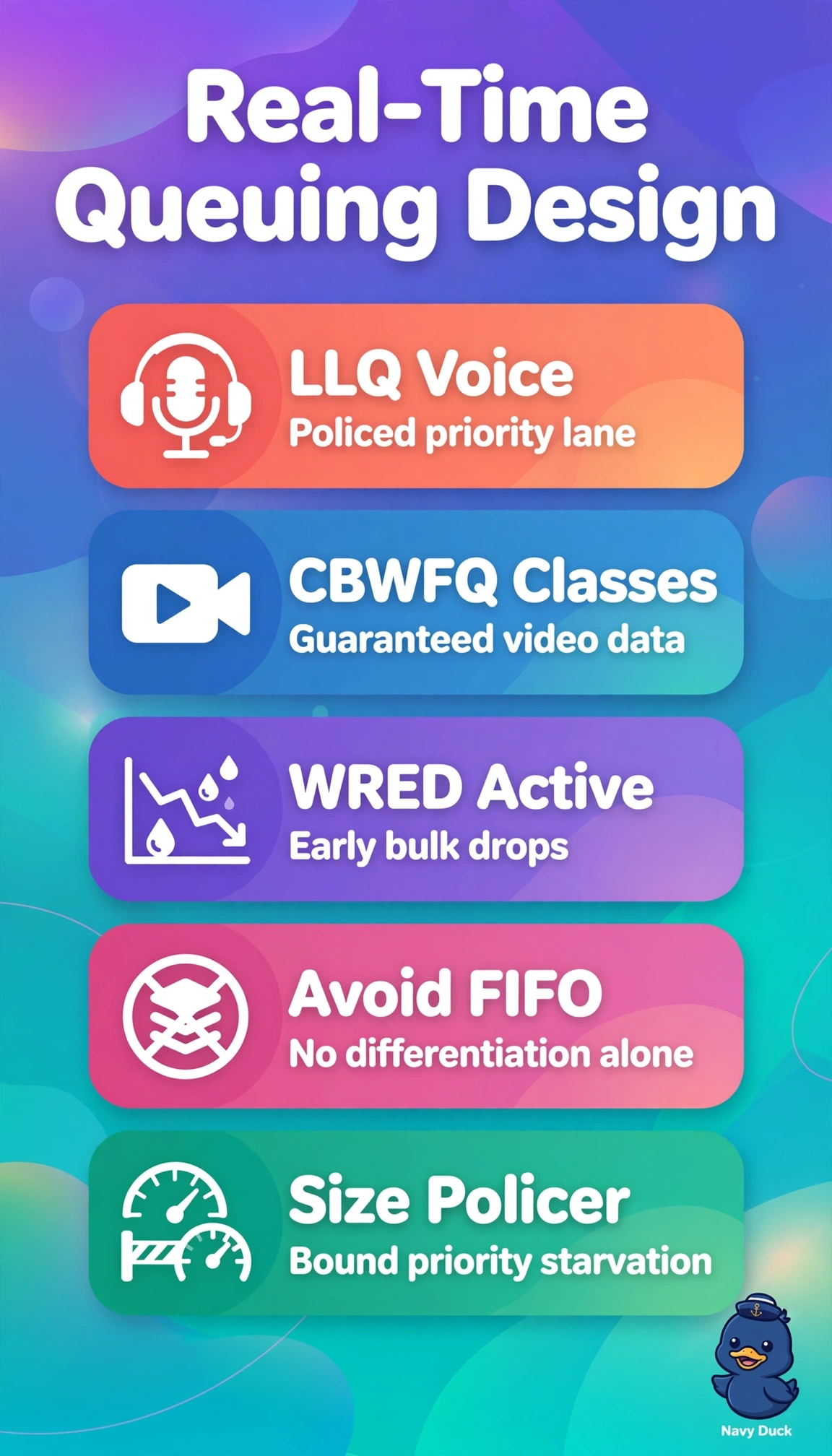
You're opening an express lane while metering the crowded on-ramps. LLQ gives voice strict priority with a policer, CBWFQ shares the rest, and WRED starts shedding bulk early.
Full Explanation
Low-latency queuing provides a policed strict-priority lane that bounds voice delay and jitter even during congestion, class-based weighted fair queuing guarantees minimum bandwidth shares for video and bulk classes so no class starves, and weighted random early detection proactively drops bulk TCP before queues fill to prevent global synchronization and tail-drop impact on real-time packets. Pure FIFO fails differentiation because all packets share one queue in arrival order, so bulk bursts inflate delay and jitter for voice without bandwidth guarantees or drop priorities. A single strict-priority queue for everything fails protection because bulk traffic would compete in the priority lane, allowing large transfers to starve or delay voice and defeating policing that keeps priority traffic bounded. Tail drop on one queue fails avoidance because drops occur only when buffers are full, causing simultaneous TCP backoff, high jitter, and indiscriminate loss that hits voice and video as hard as bulk. Exam caveat: police the priority queue and size video queues separately from voice. Practical check: verify priority bandwidth, CBWFQ shares, and WRED thresholds, then monitor drops per class during peak.