
A two-tier campus has dual distribution switches per closet with HSRP timers tuned, but failover still causes voice gaps and STP complexity. Budget allows chassis consolidation. Which platform abstraction choice using StackWise or VSS best simplifies high availability and gateway handling?
Select an answer to reveal the explanation.
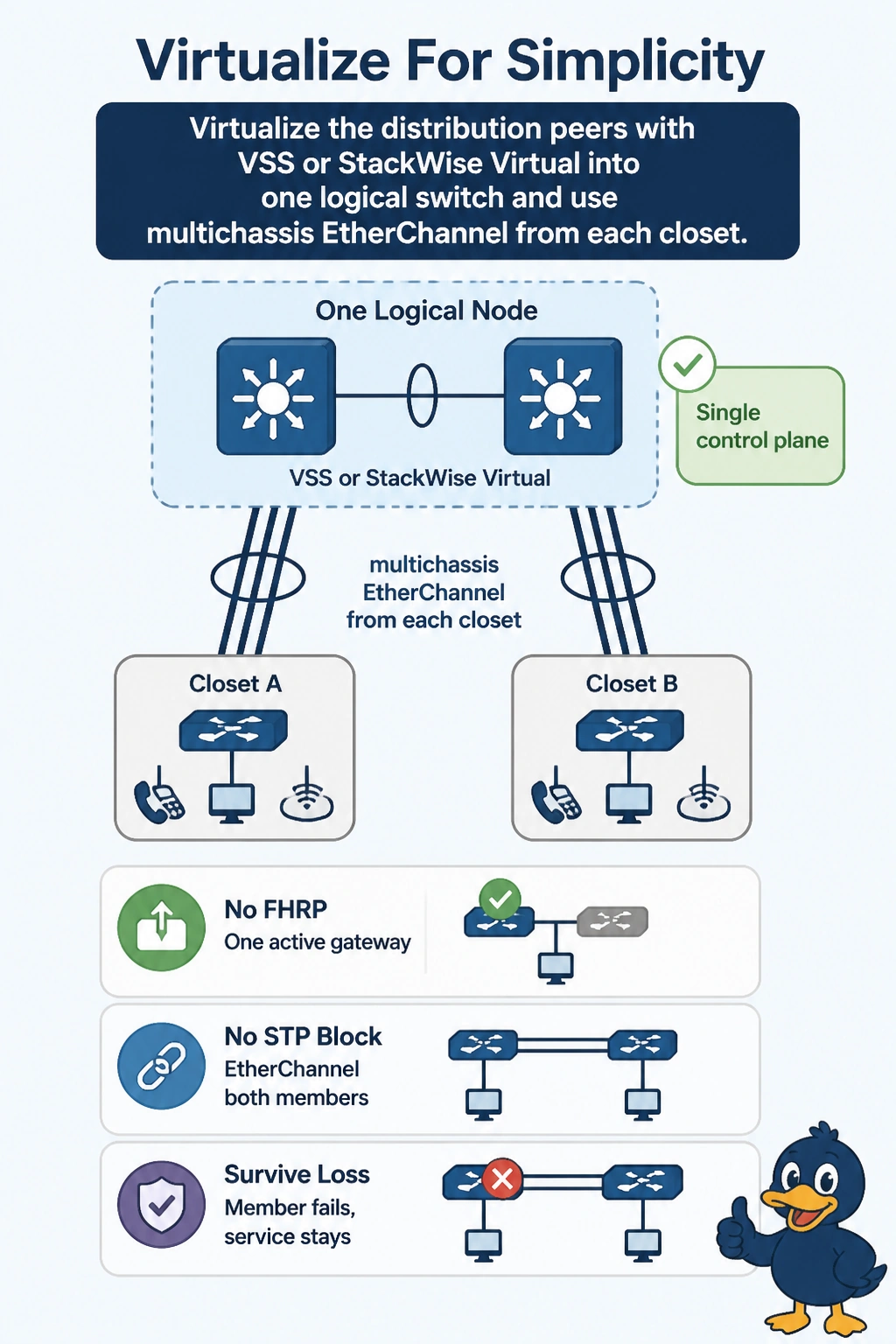
Short Explanation
You'll love how simple this gets when your two distribution switches act like twins sharing one brain — like merging two checkout lines into one. With a virtual switch, you've got no standby wait and no STP loops to trip up your voice calls.
Full Explanation
Virtualizing dual distribution peers with StackWise or VSS creates one logical switch with a single control plane and gateway, enabling multichassis EtherChannel from each closet so both uplinks forward without STP blocking or FHRP failover, which resolves voice gaps from HSRP timers and meets the funded chassis-consolidation goal. Retaining tuned HSRP over a VSS pair fails on gateway abstraction because it keeps dual hello-driven election and failover delay instead of removing first-hop redundancy as required. Stacking only access switches with StackWise while leaving distribution dual fails on scope because HSRP peering and per-VLAN spanning tree remain between distribution nodes, so timer-dependent convergence and loop management persist for voice. Consolidating distribution with VSS but preserving separate STP-blocked uplinks fails on forwarding logic because it reintroduces blocked ports and reconvergence where multichassis EtherChannel should give loop-free active-active forwarding. As an exam caveat, do not confuse faster FHRP timers or load sharing with virtualization, since tuning still leaves two control planes and does not create a single logical chassis. As a practical check, confirm one virtual domain, healthy virtual-switch links with matched code, and access MEC status with no STP blocked port and one gateway MAC before moving voice.