
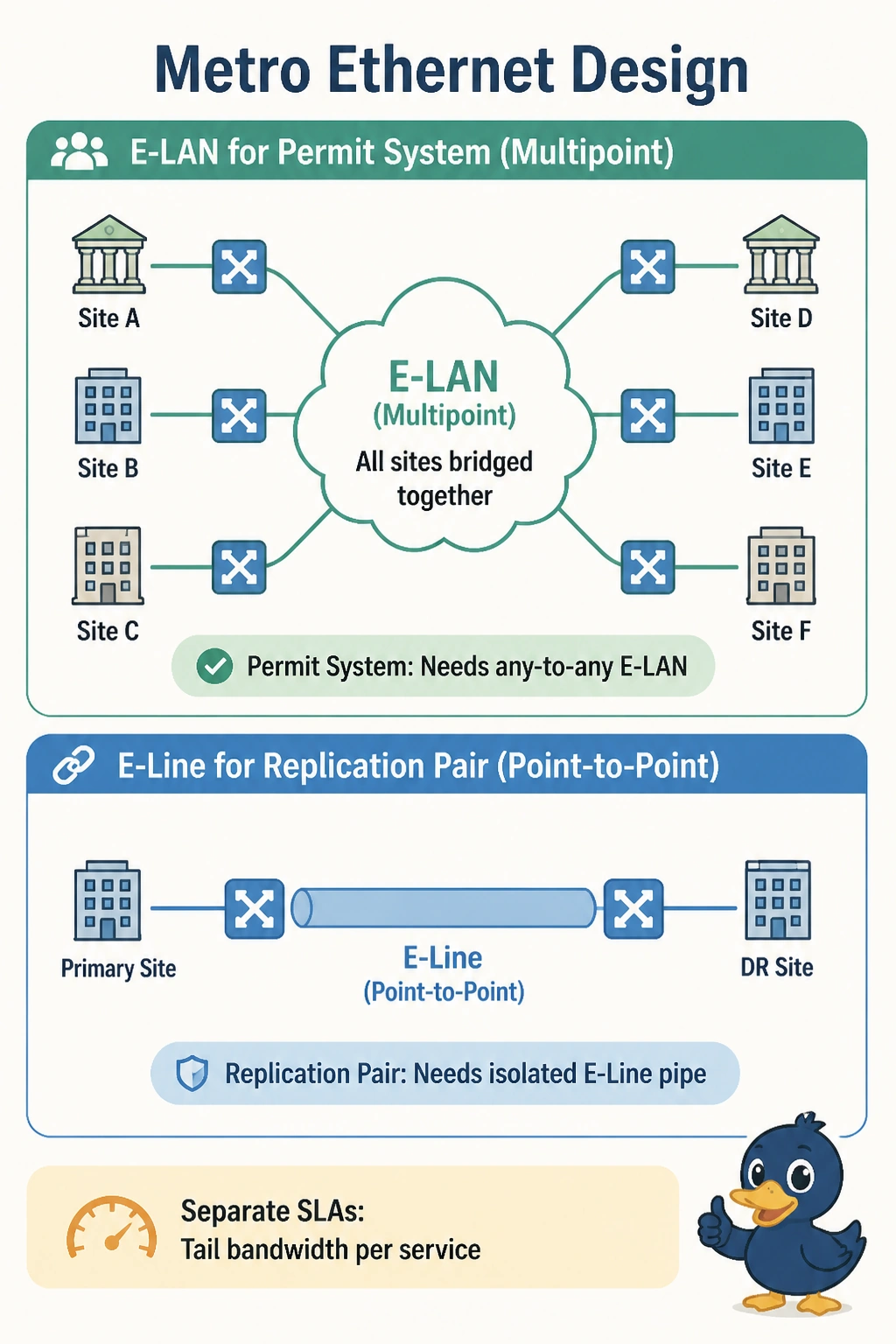
A city government must connect a data center to three service yards for a shared permit system needing multipoint bridging, plus a separate point-to-point backup link for nightly replication between two sites. The carrier proposes Metro Ethernet options. Which Metro Ethernet service design fits the bridging and point-to-point needs?
Select an answer to reveal the explanation.
Short Explanation
You'll save yourself trouble when your Ethernet shape matches your traffic. Your permit system needs multipoint sharing like a group chat, so grab E-LAN for that, while you'll use E-Line as a private direct call for nightly replication.
Full Explanation
Carrier Ethernet defines E-Line as point-to-point EVC and E-LAN as multipoint-to-multipoint EVC, so a shared bridged application across four locations maps to E-LAN while isolated replication between two sites maps to E-Line with its own bandwidth and SLA. Trying to build multipoint over a single E-Line stretches a point-to-point construct and forces hairpinning or extra routing complexity. Using E-LAN for a strict two-site replication flow over-provisions bridging where a simple pipe is cleaner, and E-Tree introduces rooted-multipoint restrictions not required here. Emulating LAN over point-to-point tags adds operational fragility and defeats service OAM intent. For the exam, associate E-Line with point-to-point and E-LAN with any-to-any bridging. In practice, verify EVC maps, VLAN preservation, MTU, and storm-control behavior for bridged sites.