
An EIGRP WAN has 300 remote spokes behind slow links, with SIA events after core link flaps and excessive queries reaching every branch. Stability requires bounded query domains while keeping branch configs simple. Which EIGRP query-scoping design meets the stability requirement?
Select an answer to reveal the explanation.
Short Explanation
Queries flooding everywhere hurt you most. Stub routing is like telling telemarketers not to call, so remotes never get queries and summaries shrink the domain.
Full Explanation
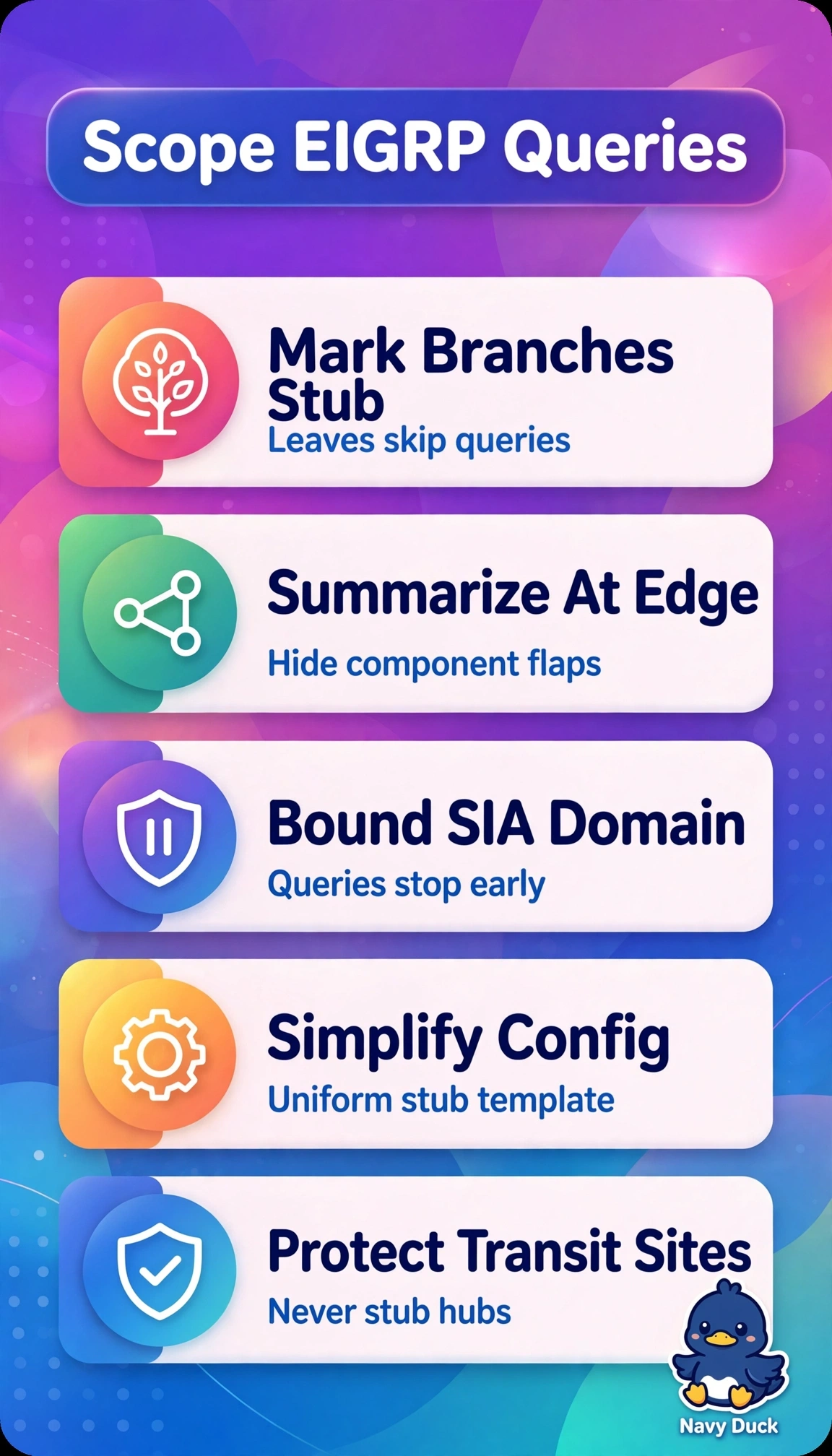
EIGRP stub routers signal they are leaves and are not queried for transit routes, while summarization at distribution creates natural query boundaries because a router that has only a summary does not query further on loss of a component, together bounding stuck-in-active domains and simplifying branches. Configuring increased stuck-in-active timers and retransmissions merely tolerates slow responses without reducing query scope, leaving 300 spokes exposed to every flap and violating the stability requirement. Configuring unequal-cost load balancing with variance improves alternate path availability through feasible successors but does not prevent queries from propagating to remotes when no feasible successor exists. Configuring full peering with route filtering only can limit advertisements yet without stub status neighbors still expect query responses, so filtering alone does not create the same reliable query boundary as stub plus summarization. For the exam, remember stub limits who gets asked and summarization limits how far queries travel, and in practice verify stub types, summary coverage, and that critical transit sites are never made stub.