
A university runs interactive video collaboration with many senders and receivers in every building, with sparse participation per group and a need to minimize source-specific state in the core. RP load must stay balanced without registering each source. Which multicast design supports many-to-many delivery for this application?
Select an answer to reveal the explanation.
Short Explanation
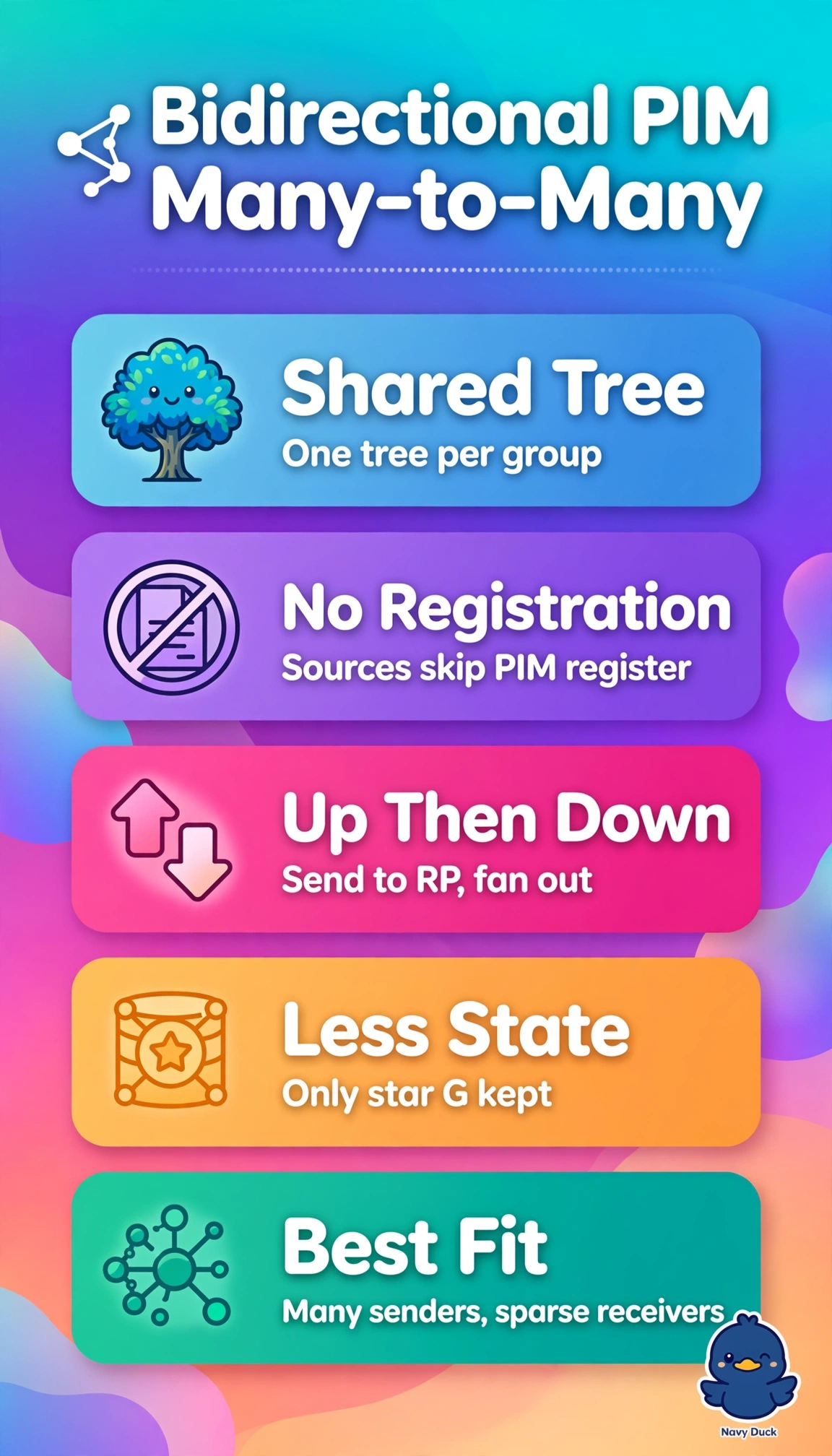
When you've got video chats popping up all over campus, you don't want your core tracking each speaker separately. It's like everyone gathering around one big conference table, since Bidirectional PIM uses a shared tree so traffic flows through the RP without source registration.
Full Explanation
Bidirectional PIM fits because it uses one bidirectional shared tree rooted at the rendezvous point, allowing traffic from any sender to flow toward the rendezvous point and then down to receivers without source registration or switchover to source-specific trees, so no per-source state is created in the core and rendezvous point load remains balanced, which supports interactive many-to-many collaboration with sparse participation in every building. The Sparse Mode design with switchover to shortest-path trees is widely used to reduce latency, but it violates the minimal-state and no-registration requirement because each active source must register and install source-specific entries for forwarding. The Dense Mode flood-and-prune design is valid where receivers are dense, but it violates the sparse-participation fact because it floods traffic before pruning branches, wasting bandwidth and processing. The Source Specific Multicast design with IGMPv3 efficiently builds receiver-driven shortest-path trees without a rendezvous point, but it violates the many-to-many requirement because each receiver must subscribe to each known sender channel, which cannot support dynamic interactive senders. As an exam caveat, shared tree wording alone does not imply bidirectional operation unless registration-free forwarding is explicit. As a practical check, confirm sparse any-to-any membership and rendezvous point redundancy and reachability before committing to this design.