
A regional hospital group has 180 clinics using 10.0.0.0/16 with overlapping subnets from mergers, heavy NAT at each site, and a five-year plan to add 300 IoT subnets and direct cloud connectivity. Growth is blocked by address conflicts and NAT troubleshooting. Which addressing strategy best supports scalable growth with simplified routing?
Select an answer to reveal the explanation.
Short Explanation
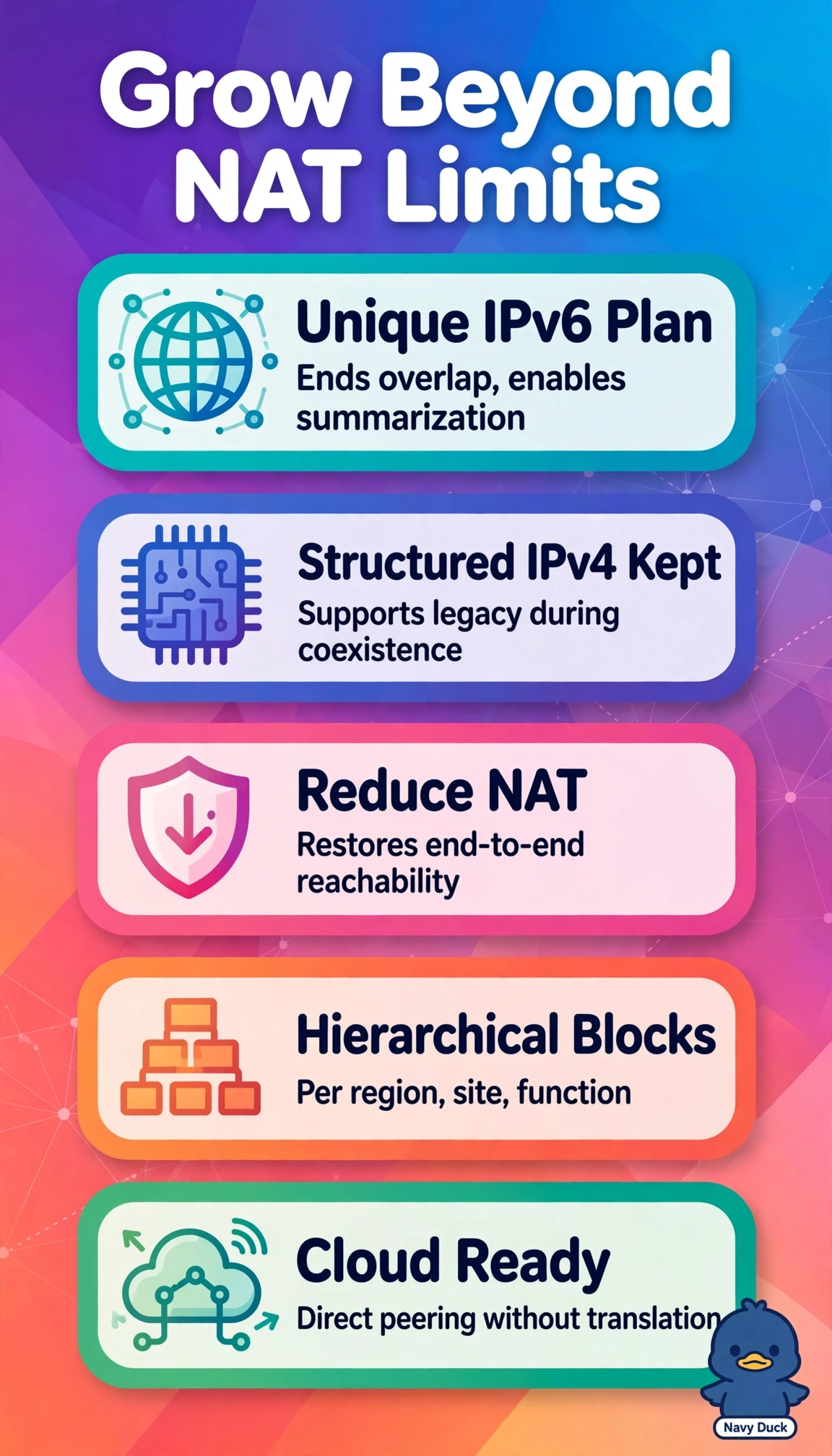
You've outgrown patchwork NAT, and clean address space is your fresh start. IPv6 gives you roomy, unique addressing that sidesteps overlaps like adding new wings without renumbering rooms. Keep structured IPv4 alongside for legacy during transition.
Full Explanation
Overlapping RFC 1918 space forces NAT everywhere, which breaks end-to-end reachability, complicates troubleshooting, and does not scale for hundreds of new IoT subnets and cloud peering. A structured IPv6 plan provides globally unique addresses, hierarchical summarization, and eliminates the need for NAT between sites and cloud, while a cleaned structured IPv4 plan supports legacy devices during coexistence. Expanding NAT pools preserves overlaps and increases state, logging, and ALG failures rather than solving growth. Migrating to public IPv4 is infeasible due to scarcity, cost, and renumbering risk, and it exposes internal hosts without solving hierarchy. Central carrier-grade NAT aggregates translation but creates a choke point, hides host identity, and still leaves edge overlaps and troubleshooting complexity intact. For the exam, remember NAT conserves addresses but never creates hierarchy or uniqueness. In practice, verify dual-stack support on clients, printers, and medical IoT before committing to timelines.