
A media company streams CEO town halls from one known studio encoder to 5,000 wired desktops, wants shortest-path delivery without rendezvous point complexity, and endpoints support modern host signaling. Which source-specific multicast design with host signaling fits this one-to-many use case?
Select an answer to reveal the explanation.
Short Explanation
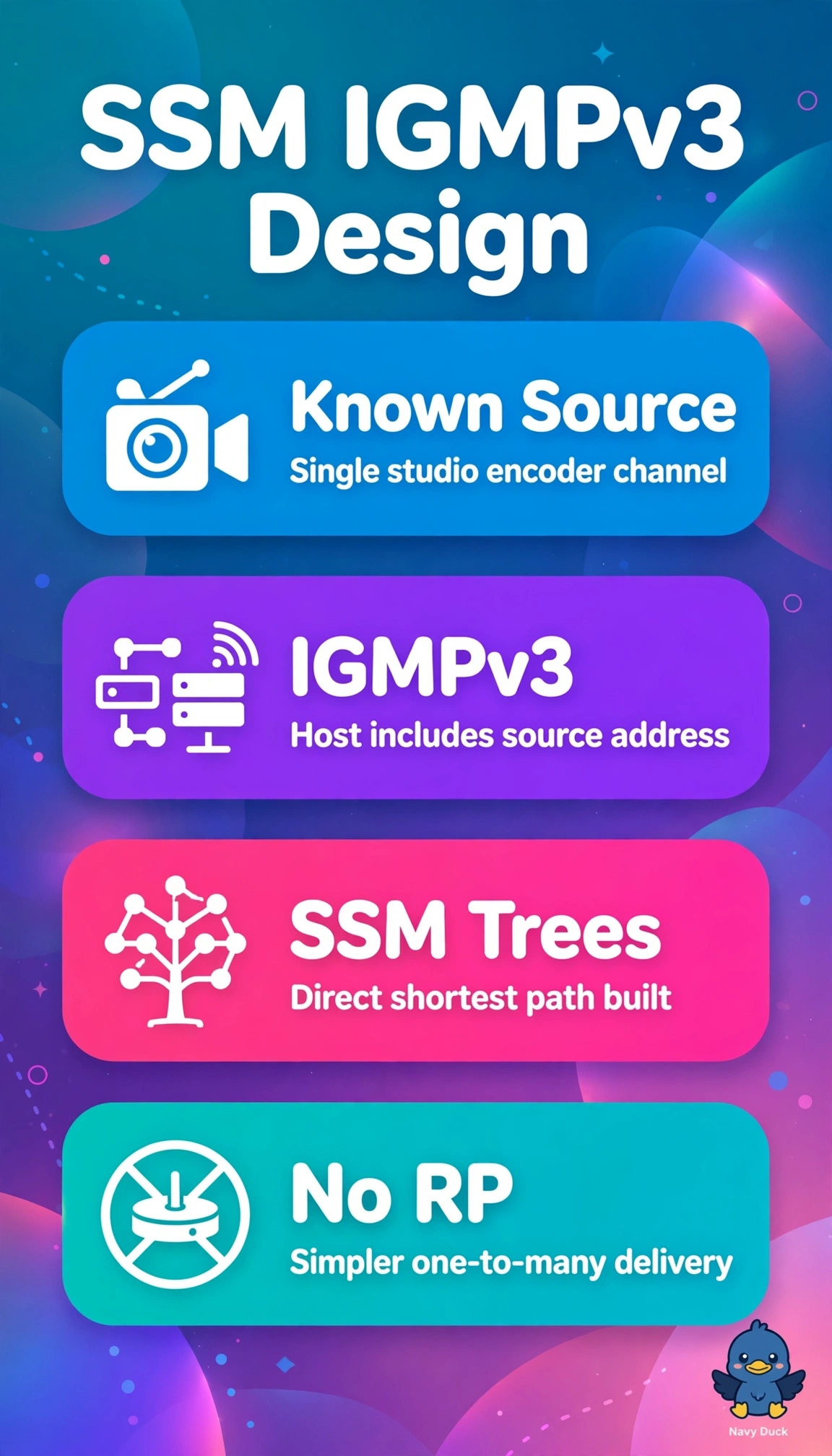
You've got one studio feeding 5,000 desks, so you'll skip the middleman and go straight to the source. With SSM and IGMPv3, your desktops request that exact channel, like tuning straight to your favorite DJ's live set instead of scanning the radio.
Full Explanation
Source-specific multicast builds shortest-path trees directly to a known (S,G) channel without a rendezvous point, and IGMPv3 provides include source signaling so hosts explicitly request the studio encoder, which matches a single-source large-receiver event. Any-Source Multicast with IGMPv2 fails by concept because it depends on RP-based shared trees and host joins that cannot specify the source, adding unnecessary complexity. Bidirectional PIM with IGMPv2 fails because bidirectional suits many-to-many traffic with shared trees and IGMPv2 lacks source-include semantics. Source-specific multicast paired with IGMPv2 also fails because IGMPv2 cannot signal source addresses, so receivers cannot express (S,G) interest. For the exam, link SSM to one-to-many known-source plus IGMPv3; in practice verify host stack support, SSM address range, and that no RP is configured for those groups.