
A sports league streams one 4K camera feed to thousands of receivers, must forward only from that known encoder, minimize RP state, and let receivers request the exact channel. Which multicast service design with host signaling best fits the single-source need?
Select an answer to reveal the explanation.
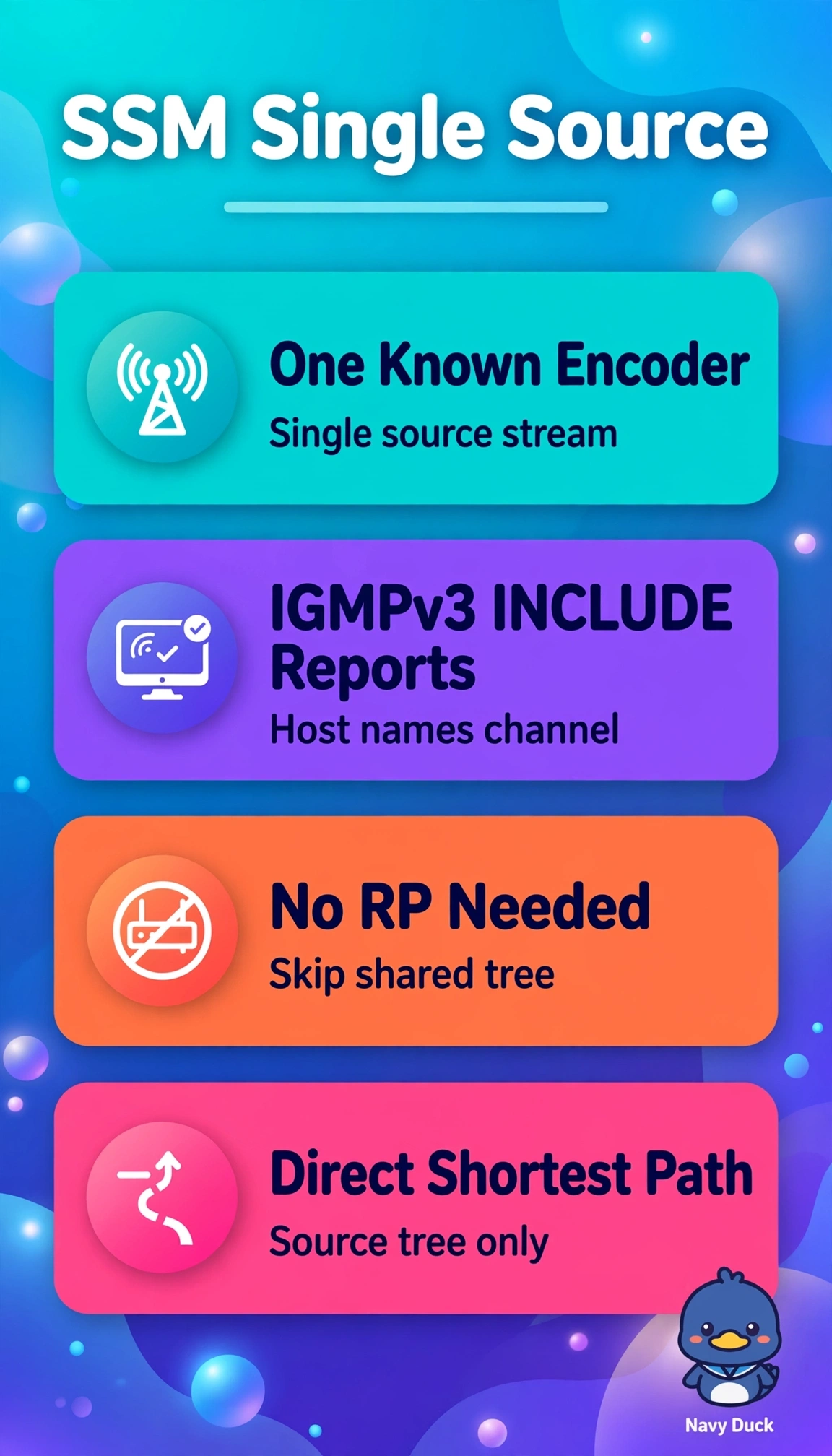
Short Explanation
One star, many fans — you don't need a middleman to find the stage. SSM plus IGMPv3 lets each receiver name the exact source and build a straight path to it.
Full Explanation
Source-specific multicast is correct because IGMPv3 INCLUDE lets receivers signal explicit (S,G) channel subscription, allowing routers to build shortest-path trees directly toward the known encoder without RP discovery, shared-tree state, or first-hop registration, which minimizes control state while enforcing forwarding only from that source for thousands of receivers on one 4K feed. The Anycast-RP sparse-mode design with IGMPv3 is sound for resilient enterprise delivery but violates single-source and minimal-RP constraints because shared trees anchored at RPs maintain (,G) state and accept traffic from redundant encoders for failover. The IGMPv2 source-specific design preserves legacy receiver compatibility and builds efficient shortest-path trees, yet it fails the exact-channel requirement because IGMPv2 supports only (,G) joins without INCLUDE source lists and cannot request a specific encoder natively. The sparse-mode design with INCLUDE signaling and prompt shortest-path switchover scales well and limits steady-state shared-tree forwarding, but it still requires RP configuration and initial (*,G) setup and therefore does not eliminate RP state. As an exam caveat, separate IGMP capability from PIM mode, since INCLUDE signaling alone does not create SSM without SSM-range configuration. As a practical check, verify SSM range, IGMPv3 membership showing source lists, and (S,G) entries with RPF toward the encoder with no RP mapping for the group.