
A logistics firm with 80 sites wants any-to-any connectivity, minimal internal routing burden, and easy addition of new warehouses without reconfiguring every router. The carrier offers point-to-point Ethernet and a shared MPLS backbone with per-customer tables. Which WAN service choice best addresses routing ownership and scaling for this growth?
Select an answer to reveal the explanation.
Short Explanation
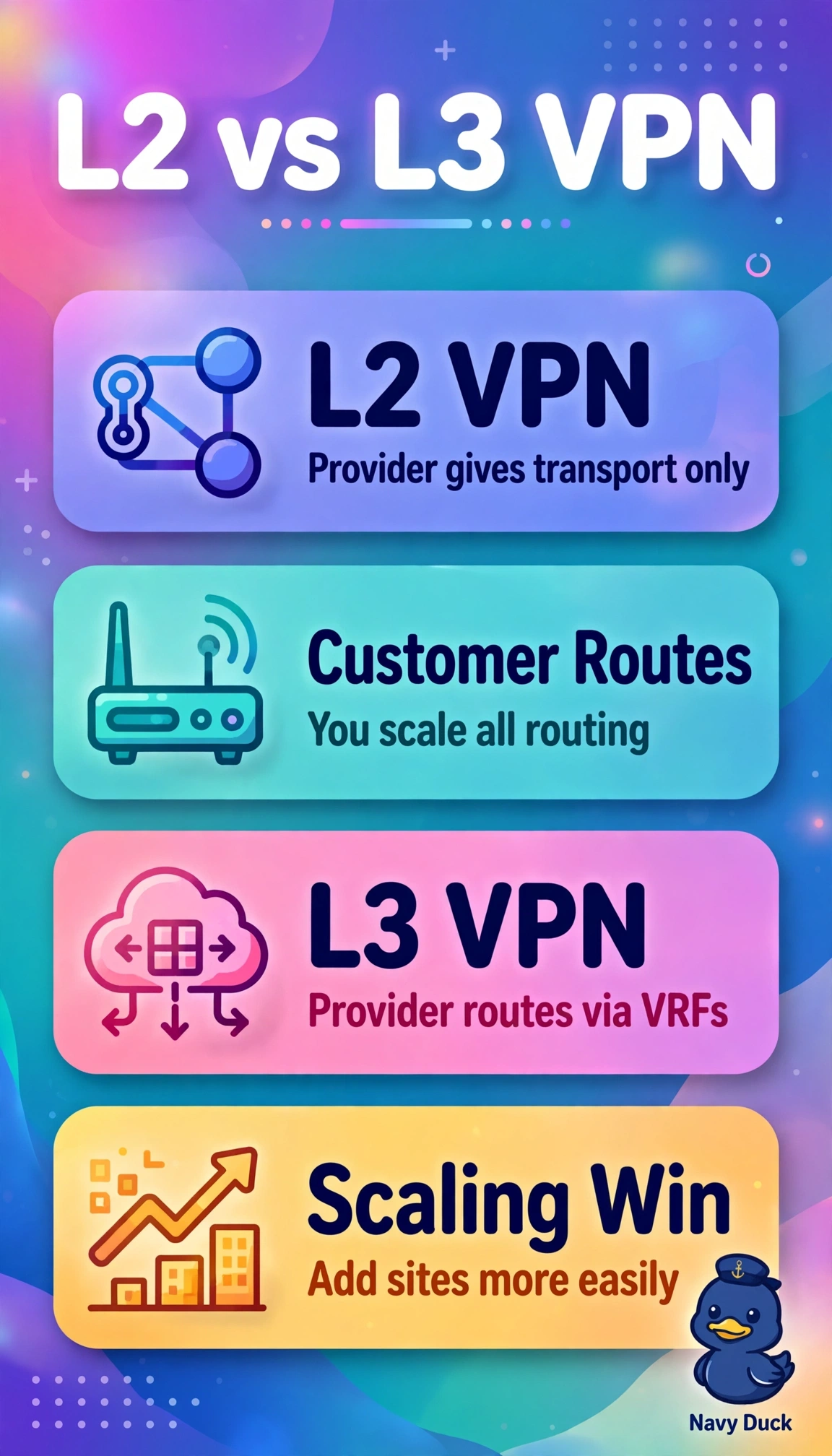
Eighty sites doing their own any-to-any routing is a full-time job you don't want. MPLS L3VPN hands inter-site routing to the provider with isolation, like letting the post office sort between cities.
Full Explanation
In an MPLS Layer 3 VPN the provider maintains per-customer VRF tables and runs PE-CE routing, so the enterprise advertises only site routes and the provider handles any-to-any distribution, which scales well when adding warehouses. A Layer 2 VPN instead provides Ethernet transport while the enterprise retains all IP routing, requiring the customer to design, peer, and scale routing across all sites. Claiming Layer 2 offloads routing to the provider misstates ownership, and running customer full-mesh OSPF over Layer 2 increases configuration and adjacency burden rather than reducing it. Claiming Layer 3 VPN leaves full control with the enterprise also inverts ownership, since control of backbone distribution moves to provider VRFs. For the exam, map routing ownership to L2 customer versus L3 provider; in practice compare operational skill, VRF isolation needs, and onboarding steps for a new site.