
A media company connects three studios over SD-WAN and must prioritize live video, limit file-transfer bandwidth during shows, and deliver one-to-many streams efficiently across the overlay. Which SD-WAN QoS and multicast design serves prioritized video over the fabric for these studios?
Select an answer to reveal the explanation.
Short Explanation
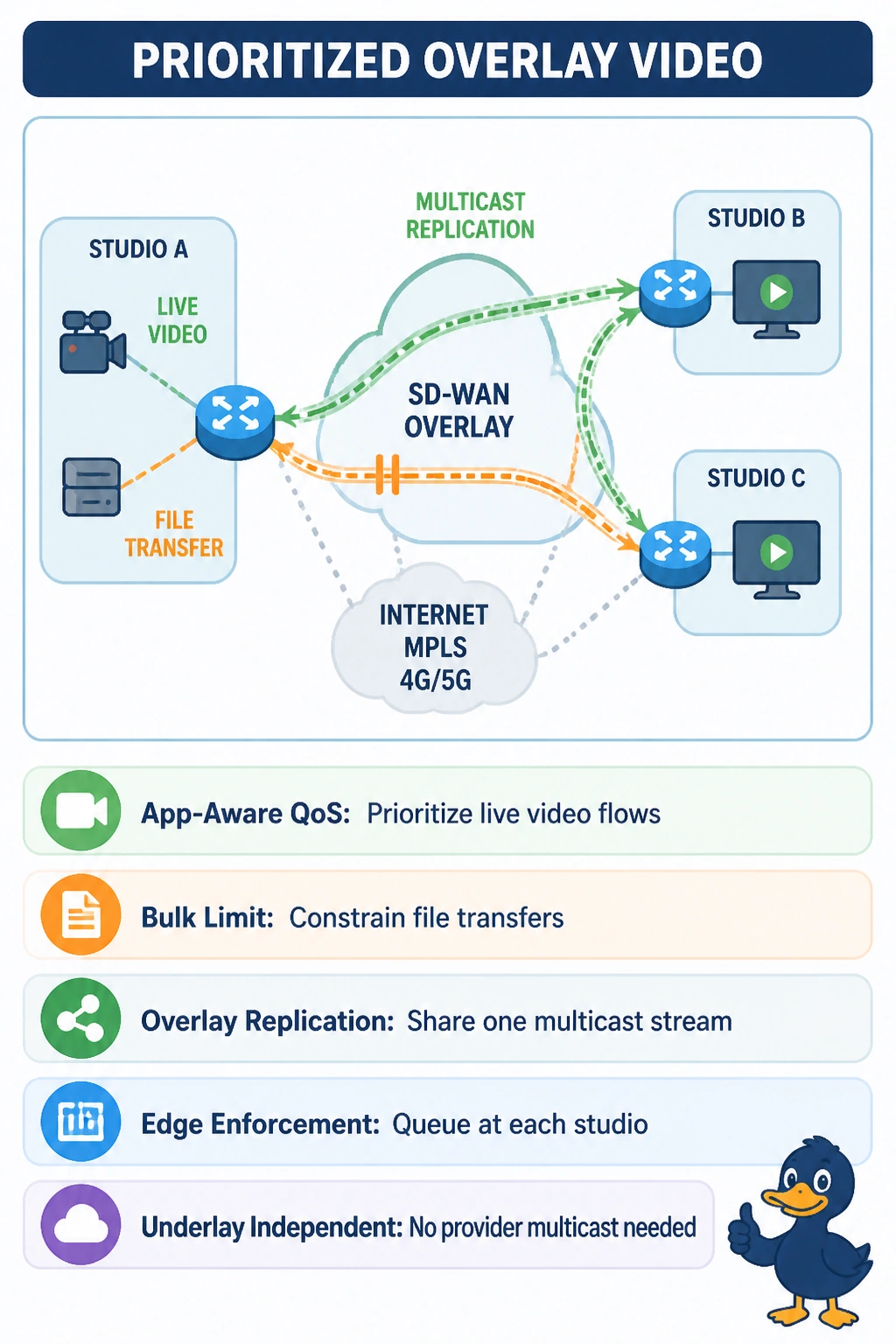
You can keep live video smooth while file transfers stay within their limits and one stream reaches all three studios efficiently. Application-aware QoS and multicast replication work together to make that happen across the overlay.
Full Explanation
Application-aware SD-WAN classifies live video and file transfers at the edge, places video in a strict-priority, low-latency queue with adequate reservation across overlay tunnels, constrains file transfers with shaping or policing during shows, and uses multicast replication so one stream serves multiple studios without per-site duplication. Together, these measures provide prioritization, bandwidth control, and efficient delivery. Rate-limiting file transfers and using multicast without priority queuing fails because efficient delivery alone cannot protect video from delay, jitter, and loss during congestion. Prioritizing video and replicating multicast without limiting file-transfer bandwidth fails because bulk TCP traffic can saturate access links and tunnel queues, degrading video during peak show load. Prioritizing video and limiting file transfers while sending separate unicast copies to each studio fails because duplicated streams waste overlay bandwidth and replication capacity compared with one-to-many forwarding. An exam caveat: confirm whether overlay multicast is native or emulated through ingress or branch replication over unicast tunnels, since vendor terminology differs. As a practical check, stage concurrent video and transfer load across all three studios, then inspect application classification, queue drops, policer counters, multicast state, and tunnel utilization.