
A branch clinic depends on a single router and ISP link for telehealth and loses all connectivity during any access failure. The redesign must survive a device, link, or provider failure without extending fate-sharing. Which high-availability branch design best limits this failure-domain requirement?
Select an answer to reveal the explanation.
Short Explanation
You'll keep your clinic online when you've got two separate ways out, like having backup exits from a building. Dual-homed routers with diverse providers keep a single device, link, or outage from taking you down.
Full Explanation
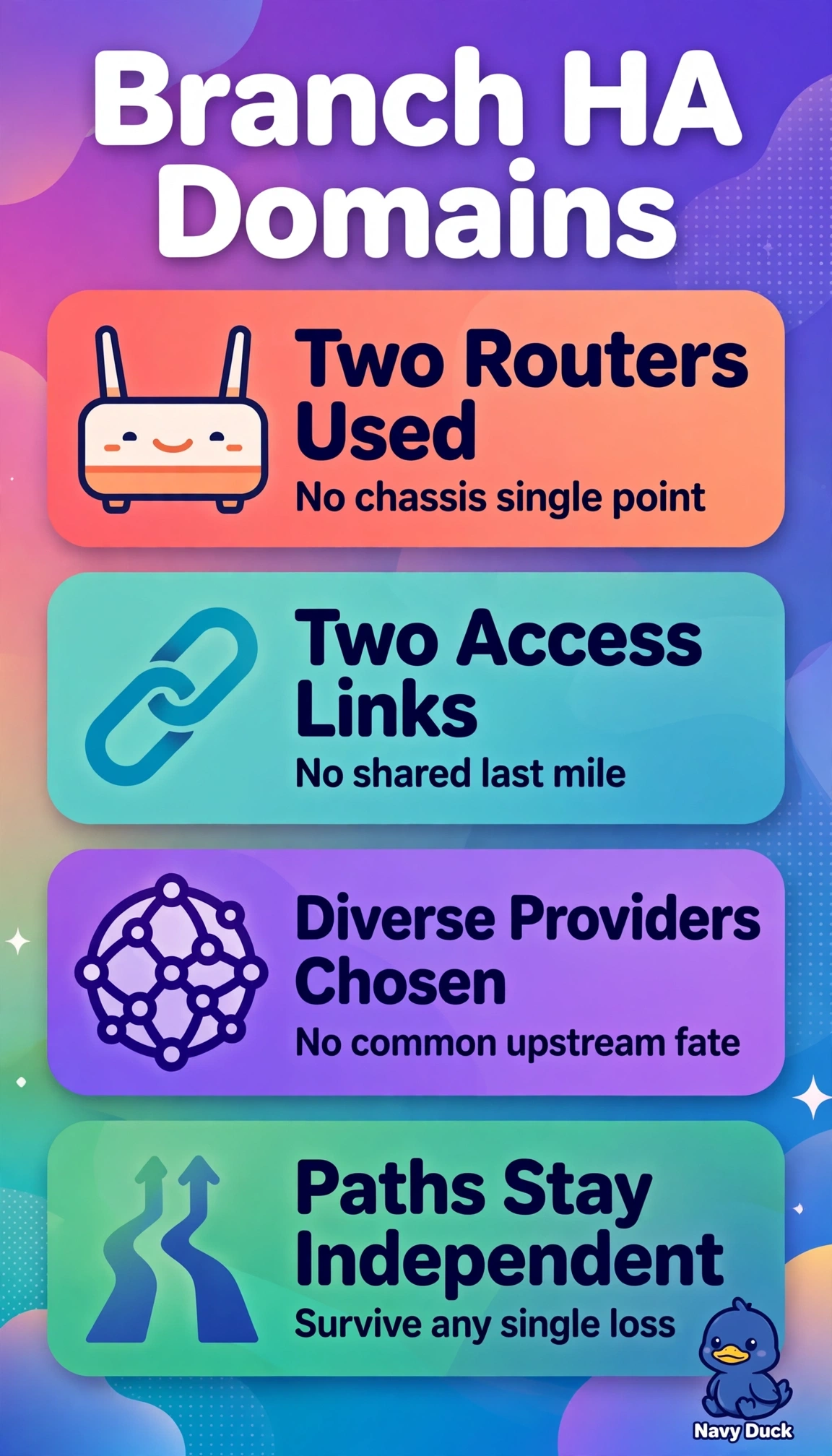
Dual routers eliminate chassis and software as single points of failure, separate access links eliminate last-mile fate-sharing, and diverse providers or provider edges eliminate upstream failure correlation, allowing routing or SD-WAN path selection to converge around any single fault while keeping failure domains disjoint. A single router with a single link retains all three fate-sharing risks regardless of timer tuning, since no alternate path exists. Dual routers on one shared link still fail together on access cuts or provider outages. A single router with two links to the same edge still shares device and upstream fate, reducing only link diversity. For the exam, map single-homed to one device-link-provider domain and dual-homed to independent domains across all layers, and in practice verify diverse physical paths, separate power, and routing failover with provider maintenance simulation.